
Ed. note: Please welcome Renee Knake Jefferson back to the pages of Above the Law. Subscribe to her Substack, Legal Ethics Roundup, here.
Welcome to what captivates, haunts, inspires, and surprises me every week in the world of legal ethics.
Hello First Monday!
What is a “First Monday” edition? Every Monday here at the LER you receive a summary of the top 10 legal ethics headlines. But, on the first Monday of the month, you get lots more — the headlines plus reading recommendations, legal ethics in pop culture, trivia, job postings, events, and more.
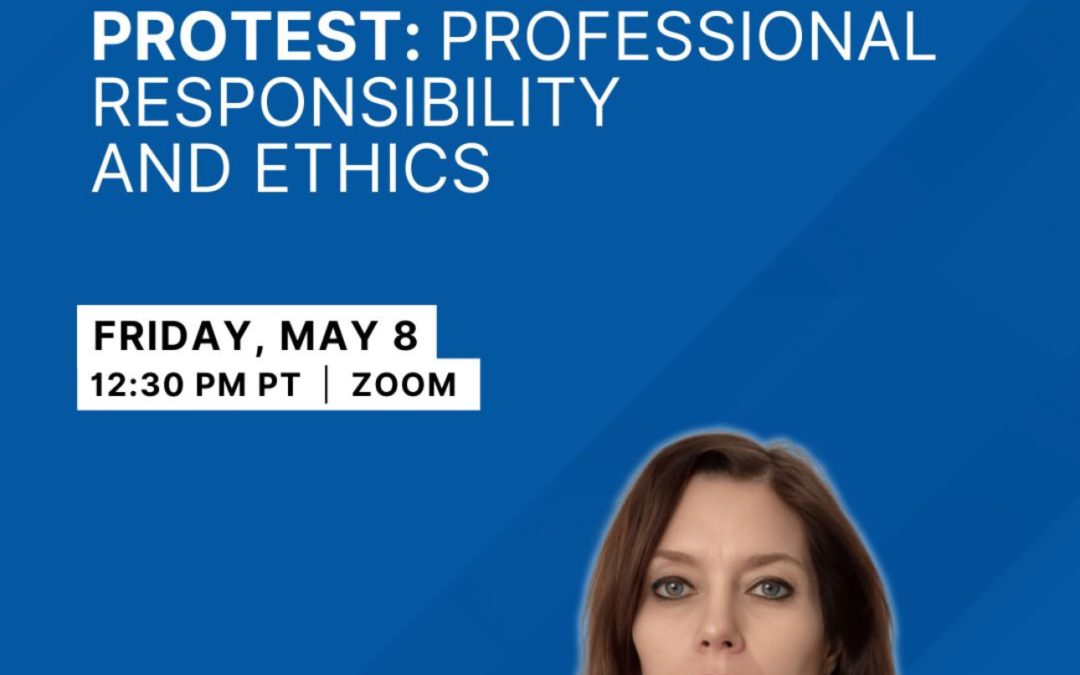
On Friday this week I’ll be speaking to the Beverly Hills Bar Association. The program title is: “When Lawyers Protest: Professional Responsibility and Ethics.” Scroll to the end to read a full description and learn more. I’ll also be recording a podcast with American Bar Association Section of Dispute Resolution on the topic of ethical uses of AI in mediation and arbitration, which should be released later this month.
Now for your headlines and other “First Monday” features. Enjoy!
Highlights from Last Week – Top 10 Headlines 📰
#1 “The Comey Indictment Could Be Upended By This 2015 Supreme Court Precedent.” From The Washington Post: “Eight legal experts interviewed for this article said the Comey indictment fails to provide evidence that the former FBI director intended his social media message as a genuine threat to the president. Under court rules, prosecutors are obligated to shape the language of their charges to conform with the current state of the law. Mary Anne Franks, a George Washington University professor who specializes in First Amendment law, said the Comey indictment fails to do that. ‘It not only should be dismissed outright, it should also mean sanctions for any lawyer who signed off on it,’ Franks said. ‘I cannot think of any possible evidence that would make this particular phrase a threat.’” Read more here (gift link).
#2 “Lawyer in AI Misuse Case Fined Over Subordinate Supervision.” From Bloomberg Law: “A California attorney failed in his professional responsibility to sufficiently supervise another lawyer at his firm who submitted court filings that contained AI-fabricated citations, a federal judge ruled. Lenden Webb, who practices in Fresno, Cali., is the latest in a fast-growing string of lawyers to be fined over misusing AI through court filings with fabricated citations. But the case appears to be rare because Magistrate Judge Peter H. Kang of the US District Court for the Northern District of California sanctioned Webb primarily for failing to oversee another lawyer at his firm for committing the underlying infraction.” Read more here.
#3 “Lawmakers Accuse Justice Department of Rushing SPLC Indictment, Citing Whistleblower Reports.” From CNN: “Lawmakers have received whistle blower reports accusing a top Justice Department official of pressuring prosecutors to work quickly to indict the Southern Poverty Law Center despite misgivings about the case, House Democrats said in a new letter to the official, Associate Deputy Attorney General Aakash Singh. Reps. Jamie Raskin and Mary Gay Scanlon are demanding that Singh provide information about the investigation, while arguing that the indictment amounted to a ‘shocking abuse of prosecutorial power to attack civil society.’” Read more here.
#4 “US Judges Advised to Disclose Event Donors Under New Ethics Policy.” From Reuters: “U.S. Supreme Court justices and federal judges on lower courts may need to disclose contributions from law firms, bar associations and former clients to fund receptions or celebrations in their honor under newly adopted ethics guidance.” Read more here. And read the underlying Judicial Conference Report here.
#5 “Six Solutions to Fix the Supreme Court.” From The Brennan Center for Justice: “Ethics scandals have further roiled the Court. Reports of justices accepting lavish trips and expensive gifts cumulating in millions of dollars, including from people with business before the Court, as well as engaging in political fundraising activities and controversial displays of partisanship, have led to public outrage yet no meaningful accountability. In recent decades, the Court has exercised extraordinary influence in a way that would have been unrecognizable to the framers. … Many may view the Court as impossible to reform. But it can be done. Article III of the Constitution, which establishes the federal judicial branch, leaves Congress with enormous control over the Court’s structure and operations. It has changed the makeup and rules of the Court many times before. It has modified justices’ duties and the Court’s docket, created recusal standards, and even altered the Court’s size and jurisdiction. It is time for Congress to act once again and return the Court to its proper place in the U.S. constitutional system. Congress must pass urgently needed reforms, including the following.” Read more here.
#6 “I Filed for Roberts’s Disbarment. Then This Happened.” From The Existentialist Republic Substack: “A week ago I mailed a formal disciplinary complaint against Chief Justice John Roberts to the District of Columbia Bar Office of Disciplinary Counsel. The paperwork is at the bottom of this article in full, with my personal information redacted. I want to answer a few questions, recount what’s happened since, and share some resources.” Read more here.
#7 “Federal Judge Limits Sanction for DOJ Attorney Fired Over AI Errors.” From the ABA Journal: “A federal judge has formally reprimanded a former assistant U.S. attorney who was fired in March for using generative artificial intelligence to draft a brief and failing to verify its accuracy. U.S. Magistrate Judge Robert T. Numbers II of the Eastern District of North Carolina said in an order Tuesday former Assistant U.S. Attorney Rudy Renfer ‘knowingly submitted a brief containing fabricated quotations and misstatements of case holdings’ and should be held accountable. But he chose not ‘to impose a significant sanction.’” Read more here.
#8 “Bay Area TV [Lawyer] Ads Suggest Life is a Continuous Cycle of Disaster, Litigation” From the San Francisco Chronicle: “But what really got me was the avalanche of ads for personal injury attorneys, ready to fight injustice 24 hours a day all at no cost to you. I began to feel that on television at least, the world is full of accidents, or illnesses, or mishaps of some kind. And somebody’s to blame. Sue them. One ad shows the usual car crashes, and even a kid simply falling down. The implication: He should sue his mother.” Read more here.
#9 “As AI Blunders Pile Up, Law Firms Address Ethics Implications of New Technology.” From The American Lawyer: “The American Lawyer spoke with Morgan Lewis chief AI and knowledge officer Colleen Nihill and chief legal talent officer Noelani Walser about how law firms are addressing the ethical risks associated with increasing use of artificial intelligence (AI) in legal practice. The article examines how firms are expanding AI training to emphasize governance, responsibility, and ethical use alongside technical proficiency, particularly in response to high-profile errors involving AI-generated content.” Read more here.
#10 “Private Equity MSO Deal Lawyers – The Holland & Knight Lawyers Closing 15+ Law Firm Transactions in Six Months.” From Law Fuel: “The quiet revolution in law firm ownership is no longer quiet it appears as Holland & Knight is proving. Private equity and venture capital are pouring into the legal industry as we have reported and they are now working through management services organizations (MSOs), which is the compliant workaround to traditional non-lawyer ownership bans. And the pace is accelerating faster than anyone expected. Holland & Knight’s legal services transactions team, led by ethics partner Trisha Rich and private equity attorney Joshua Porte, has closed more than 15 MSO deals in just the last six months and is actively working on 100 more, the firm told Reuters at an invite-only conference in New York last week.” Read more here.
Recommended Reading 📖
So much great reading in legal ethics is out in the world right now. The first on my list this month is a two-for-one — I recommend reading both Romero’s article “Gossip” and Litman’s review of it. The second is a book, one worth highlighting now but don’t worry the annual legal ethics summer book list is still in the works!
“Lady Whisteldown…and the Legal Academy?” in Jotwell by Leah Litman (Michigan) reviewing “Gossip” by Maybell Romero (Tulane). From the abstract:
There’s no one like Professor Maybell Romero in the legal academy (I say this, a la Violet Chachki, as a compliment, not a read).
In a searing article from several years ago, Ruined, Romero used her own experiences with rape and sexual assault to critique how the law and legal profession describe survivors as “ruined,” “broken,” or “destroyed.” Then, in Shamed, Romero expanded the lens: She used personal narrative and auto-ethnographic methods and applied them to individuals and institutions within the legal academy. That piece explored how survivors are shamed, in addition to being described as ruined—sometimes by members of the legal academy, as Romero recounts when describing (some of) the reaction to Ruined.
Romero’s latest intervention, Gossip, is even more laser focused on the legal academy. It explains why the legal academy relies on gossip as a governance structure (meaning an informal system of regulation) for addressing sexual misconduct. The piece is, once again, a difficult but necessary read.
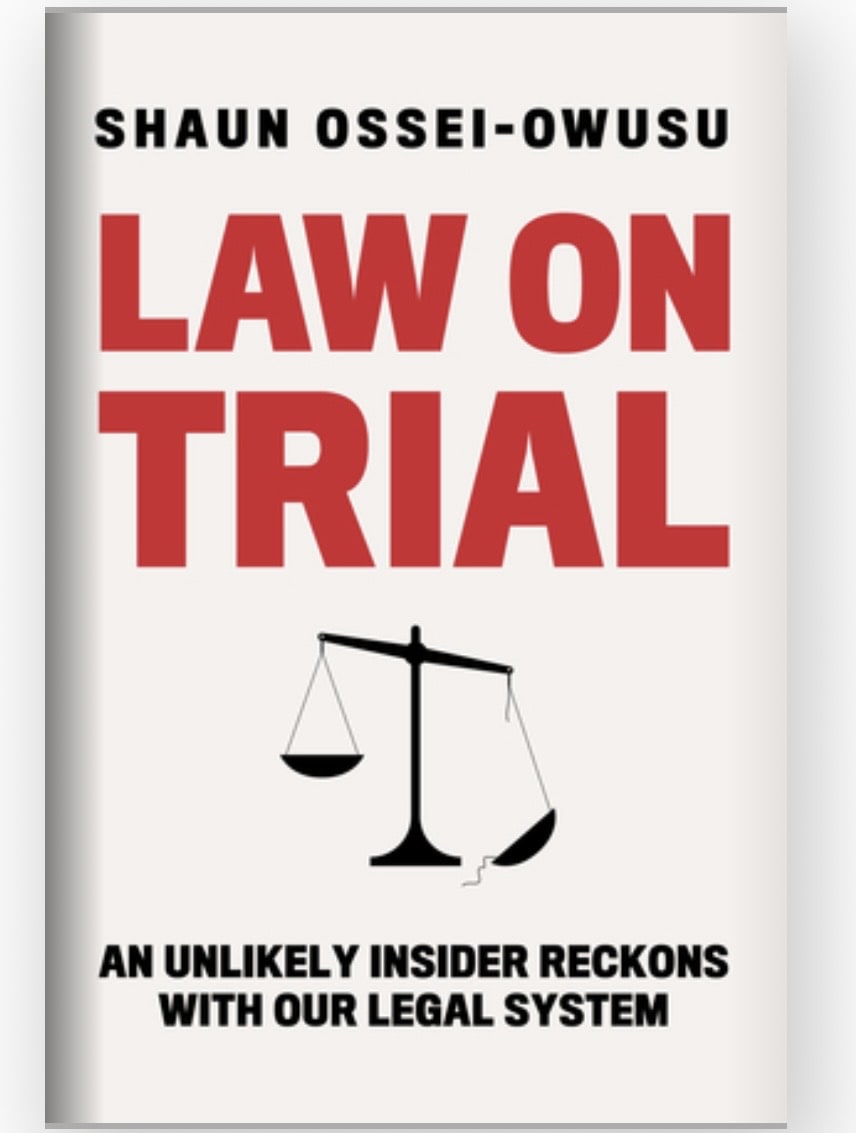
“Law on Trial” by Shaun Ossei-Owusu (Penn). From the publisher:
The law promises justice. Too often, it delivers inequality. This contradiction raises a basic question: Why does a legal system that claims to stand for fairness and equality fail to uphold these ideals over and over? In Law on Trial, legal scholar and Bronx native Shaun Ossei-Owusu draws on more than a decade of observation and reflection—first as a scholar of inequality, then as a law student, practicing lawyer, and now as an Ivy League law professor—to provide an unvarnished account of the legal system. He reveals that the promise of justice is too often a convenient fiction invoked by lawyers, recited by textbooks, and betrayed in practice. Street crime gets the fist of the state; white-collar crime gets a gentle hand. Laws meant to protect women and minorities are increasingly turned against them. Immigrants face the law with only the thinnest protections, while the rights of people with disabilities are routinely ignored. And, most quietly, lawyer-driven corporate deals shutter small-town hospitals, deepening America’s abandonment of the rural poor. These are not aberrations, but simply how law works in this country.
In this legal odyssey, Ossei-Owusu takes us inside law school classrooms where human suffering is reduced to abstract principles. He brings us to government offices where protecting cities can mean crushing the vulnerable. We go to Big Law conference rooms where power is exercised far from the communities most affected. At every step, he pulls back the curtain on legal education and the legal profession, creating a revelatory, unforgettable account of a system that touches all of us, in one way or another. A book for nonlawyers, law students, and practicing lawyers alike, Law on Trial explains how a legal system dedicated to fairness is behind many of the social ills of our time, and shows how it can be fixed.
Legal Ethics in Pop Culture 🍿
“Best Legal Shows to Watch: 18 Realistic and Entertaining Law Series.” From the National Jurist: “Some legal shows offer a close look at real practice, ethics and courtroom strategy. Others lean into drama, humor or high-stakes storytelling. Both can offer insight into the profession.” Read about all 18 shows, from the most realistic to the most entertaining, here.
Legal Ethics Trivia 🧩
From the Texas Center for Legal Ethics, here’s the question of the month: “Is this attorney required to notify the Office of the Chief Disciplinary Counsel about being placed on probation?” Test yourself at this website where you can read a short hypothetical, select an answer, and see your results. So far, no one has gotten it right. Will you?

Get Hired 💼
Did you miss the 500+ job postings from previous weeks? Find them all here.
Conflicts & Ethics Attorney, King & Spaulding — Various Locations. From the posting: “Conduct comprehensive reviews of new business intake forms, conflict reports, and engagement terms to identify and resolve potential business and ethical conflicts, ensuring full compliance with Firm policies prior to matter initiation. Draft and review waiver letters, engagement letters, and communicate with lawyers and staff on any changes or additional information that may be necessary before the Firm can accept the new business. Advise on issues under the rules of professional responsibility.” Learn more and apply here.
Legal Director, Global Ethics & Compliance, Kohler — Kohler, WI. Learn more and apply here.
Litigation Counsel, Citizens for Responsibility and Ethics in Washington — Washington DC. From the posting: “Citizens for Responsibility and Ethics in Washington (CREW) seeks a passionate and creative Litigation Counsel to join our legal team and help us secure our democracy and build a better Washington. This position is a unique opportunity to be on the front lines of the fight for a more ethical, accountable, and open government, while working alongside smart, dedicated and kind people. As a leading nonpartisan nonprofit government watchdog, CREW is dedicated to preserving our democratic institutions, upholding the rule of law, defending against threats to free and fair elections, rooting out government misconduct and corruption and fighting the influence of money in politics through legal action and communications grounded by in-depth research. CREW is looking for a creative, driven attorney committed to our mission and values. We welcome diverse skills, backgrounds and experiences.” Salary range $145,000-$165,000. Learn more and apply here.
Public Affairs Counsel: Legal Ethics & Media Strategy, State Bar of Texas — Austin. From the posting: “A governmental legal organization in Texas seeks a professional to manage media relations and educational outreach regarding attorney grievances and discipline. This role requires a J.D., Texas law license, and a minimum of five years in communications. Responsibilities include handling media inquiries, developing educational materials, and assisting with legislative matters.” Learn more and apply here.
Staff Attorney, Texas Board of Bar Examiners — Austin/Remote. From the posting: “The Staff Attorney represents the Board in character and fitness hearings, evaluates requests for testing accommodations, assists with public information requests, and assists with administering the Texas bar exam.” Learn more and apply here.
Staff Attorney, Deborah L. Rhode Center on the Legal Profession at Stanford Law School — Palo Alto. From the posting: ”The Staff Attorney will serve as a key legal advisor to the Center and will be responsible for conducting in-depth legal research and analysis, monitoring developments in case law and legislation, and translating the Center’s empirical research into practical legal recommendations. The Staff Attorney will focus on the Center’s brief-writing and amicus advocacy work—helping courts across the country adopt evidence-based reforms in MDL practice, contingency-fee transparency, and civil litigation integrity. The Staff Attorney will work closely with the Center’s Faculty Co-Directors (Nora Freeman Engstrom and David Freeman Engstrom) and report to the Center’s Executive Director (Malka Herman).” Salary range $116,966 to $150,114. Learn more and apply here.
Upcoming Ethics Events & Other Announcements 🗓️
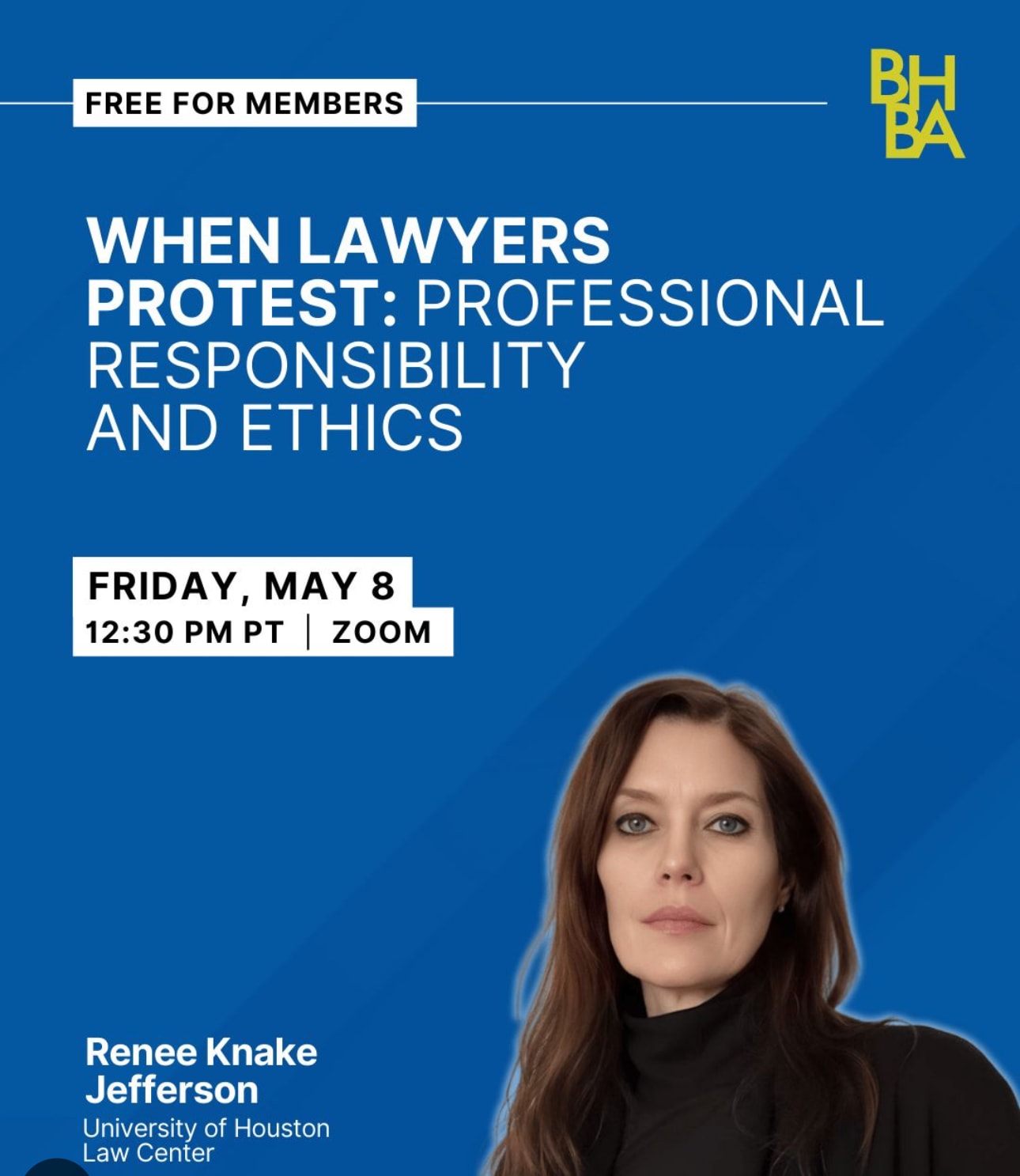
May 8, 12:30-1:30PM Pacific. Beverly Hills Bar Association, “When Lawyers Protest: Professional Responsibility and Ethics.” Join me via Zoom where I’ll be discussing my forthcoming Michigan Law Review piece “When Lawyers Protest.” From the program description: “Lawyers are increasingly visible in moments of public protest, civic action, and political expression. Join law professor and ethics expert Renee Knake Jefferson for a timely and practical examination of how professional responsibility rules apply when lawyers engage in protest and other forms of public participation. This program goes beyond the question of whether lawyers may protest to explore what the legal profession owes to the public when its members do. Drawing on recent, real-world examples, the ABA Model Rules, disciplinary cases, and emerging scholarship, the session will examine how ethical duties related to professionalism, public confidence in the justice system, and lawyer conduct intersect with civic engagement. Participants will leave with a clearer understanding of where ethical boundaries lie, how those boundaries are shifting, and how to navigate public action without jeopardizing professional standing or public trust.” Learn more and register here.
May 13, 10-11AM Pacific. Stanford Law School Rhode Center on the Legal Profession. Lawyers’ Monopoly Webinar Series 3: The Comparative Lens. Learn more and register here.
May 27-29. ABA 51st Conference on Professional Responsibility, UCLA Meyer and Renee Luskin Conference Center, Los Angeles. Learn more here.
May 29-30. ABA 41st National Forum on Client Protection, UCLA Meyer and Renee Luskin Conference Center, Los Angeles. Learn more here.
June 24, 10-11AM Pacific. Stanford Law School Rhode Center on the Legal Profession. Lawyers Monopoly Webinar Series #4: Charting the Future of Legal Services. Learn more and register here.
June 25-26. International Association of Legal Ethics Berlin Conference:“The Legal Professions in Times of Rule of Law and Democratic Backsliding.” I’ll be there speaking on a panel entitled: “Legal Mobilization to Save Democracy and the Rule of Law in the United States.” Learn more and register here.
July 30-August 1. Association of Professional Responsibility Lawyers Annual Meeting, Chicago. Learn more here.
October 15-16. Complex Litigation Ethics Conference, UC Law San Francisco. The conference is the fourth annual event addressing Complex Litigation Ethics. It will bring together luminaries in the field—judges, scholars, lawyers, and others—to discuss a cutting-edge topic that is of critical importance to our justice system. Learn more here.
December 9-11. International Legal Ethics Conference, National University of Singapore, Faculty of Law. Learn more here.
Keep in Touch 📝
Do you have colleagues who care about legal ethics? Please share the Roundup with them. I’d love to see our community continue to grow!
News tips? Announcements? Events? A job to post? Reading recommendations? Email legalethics@substack.com – but be sure to subscribe first, otherwise the email won’t be delivered.
Renee Knake Jefferson holds the endowed Doherty Chair in Legal Ethics and is a Professor of Law at the University of Houston. Check out more of her writing at the Legal Ethics Roundup. Find her on X (formerly Twitter) at @reneeknake or Bluesky at legalethics.bsky.social.
The post Legal Ethics Roundup: Supervising Lawyer Sanctioned For AI Use, Donor Disclosures For Judges, Private Equity In Law Firms, Best Legal Shows & More appeared first on Above the Law.
Ed. note: Please welcome Renee Knake Jefferson back to the pages of Above the Law. Subscribe to her Substack, Legal Ethics Roundup, here.
Welcome to what captivates, haunts, inspires, and surprises me every week in the world of legal ethics.
Hello First Monday!
What is a “First Monday” edition? Every Monday here at the LER you receive a summary of the top 10 legal ethics headlines. But, on the first Monday of the month, you get lots more — the headlines plus reading recommendations, legal ethics in pop culture, trivia, job postings, events, and more.
On Friday this week I’ll be speaking to the Beverly Hills Bar Association. The program title is: “When Lawyers Protest: Professional Responsibility and Ethics.” Scroll to the end to read a full description and learn more. I’ll also be recording a podcast with American Bar Association Section of Dispute Resolution on the topic of ethical uses of AI in mediation and arbitration, which should be released later this month.
Now for your headlines and other “First Monday” features. Enjoy!
Highlights from Last Week – Top 10 Headlines 📰
#1 “The Comey Indictment Could Be Upended By This 2015 Supreme Court Precedent.” From The Washington Post: “Eight legal experts interviewed for this article said the Comey indictment fails to provide evidence that the former FBI director intended his social media message as a genuine threat to the president. Under court rules, prosecutors are obligated to shape the language of their charges to conform with the current state of the law. Mary Anne Franks, a George Washington University professor who specializes in First Amendment law, said the Comey indictment fails to do that. ‘It not only should be dismissed outright, it should also mean sanctions for any lawyer who signed off on it,’ Franks said. ‘I cannot think of any possible evidence that would make this particular phrase a threat.’” Read more here (gift link).
#2 “Lawyer in AI Misuse Case Fined Over Subordinate Supervision.” From Bloomberg Law: “A California attorney failed in his professional responsibility to sufficiently supervise another lawyer at his firm who submitted court filings that contained AI-fabricated citations, a federal judge ruled. Lenden Webb, who practices in Fresno, Cali., is the latest in a fast-growing string of lawyers to be fined over misusing AI through court filings with fabricated citations. But the case appears to be rare because Magistrate Judge Peter H. Kang of the US District Court for the Northern District of California sanctioned Webb primarily for failing to oversee another lawyer at his firm for committing the underlying infraction.” Read more here.
#3 “Lawmakers Accuse Justice Department of Rushing SPLC Indictment, Citing Whistleblower Reports.” From CNN: “Lawmakers have received whistle blower reports accusing a top Justice Department official of pressuring prosecutors to work quickly to indict the Southern Poverty Law Center despite misgivings about the case, House Democrats said in a new letter to the official, Associate Deputy Attorney General Aakash Singh. Reps. Jamie Raskin and Mary Gay Scanlon are demanding that Singh provide information about the investigation, while arguing that the indictment amounted to a ‘shocking abuse of prosecutorial power to attack civil society.’” Read more here.
#4 “US Judges Advised to Disclose Event Donors Under New Ethics Policy.” From Reuters: “U.S. Supreme Court justices and federal judges on lower courts may need to disclose contributions from law firms, bar associations and former clients to fund receptions or celebrations in their honor under newly adopted ethics guidance.” Read more here. And read the underlying Judicial Conference Report here.
#5 “Six Solutions to Fix the Supreme Court.” From The Brennan Center for Justice: “Ethics scandals have further roiled the Court. Reports of justices accepting lavish trips and expensive gifts cumulating in millions of dollars, including from people with business before the Court, as well as engaging in political fundraising activities and controversial displays of partisanship, have led to public outrage yet no meaningful accountability. In recent decades, the Court has exercised extraordinary influence in a way that would have been unrecognizable to the framers. … Many may view the Court as impossible to reform. But it can be done. Article III of the Constitution, which establishes the federal judicial branch, leaves Congress with enormous control over the Court’s structure and operations. It has changed the makeup and rules of the Court many times before. It has modified justices’ duties and the Court’s docket, created recusal standards, and even altered the Court’s size and jurisdiction. It is time for Congress to act once again and return the Court to its proper place in the U.S. constitutional system. Congress must pass urgently needed reforms, including the following.” Read more here.
#6 “I Filed for Roberts’s Disbarment. Then This Happened.” From The Existentialist Republic Substack: “A week ago I mailed a formal disciplinary complaint against Chief Justice John Roberts to the District of Columbia Bar Office of Disciplinary Counsel. The paperwork is at the bottom of this article in full, with my personal information redacted. I want to answer a few questions, recount what’s happened since, and share some resources.” Read more here.
#7 “Federal Judge Limits Sanction for DOJ Attorney Fired Over AI Errors.” From the ABA Journal: “A federal judge has formally reprimanded a former assistant U.S. attorney who was fired in March for using generative artificial intelligence to draft a brief and failing to verify its accuracy. U.S. Magistrate Judge Robert T. Numbers II of the Eastern District of North Carolina said in an order Tuesday former Assistant U.S. Attorney Rudy Renfer ‘knowingly submitted a brief containing fabricated quotations and misstatements of case holdings’ and should be held accountable. But he chose not ‘to impose a significant sanction.’” Read more here.
#8 “Bay Area TV [Lawyer] Ads Suggest Life is a Continuous Cycle of Disaster, Litigation” From the San Francisco Chronicle: “But what really got me was the avalanche of ads for personal injury attorneys, ready to fight injustice 24 hours a day all at no cost to you. I began to feel that on television at least, the world is full of accidents, or illnesses, or mishaps of some kind. And somebody’s to blame. Sue them. One ad shows the usual car crashes, and even a kid simply falling down. The implication: He should sue his mother.” Read more here.
#9 “As AI Blunders Pile Up, Law Firms Address Ethics Implications of New Technology.” From The American Lawyer: “The American Lawyer spoke with Morgan Lewis chief AI and knowledge officer Colleen Nihill and chief legal talent officer Noelani Walser about how law firms are addressing the ethical risks associated with increasing use of artificial intelligence (AI) in legal practice. The article examines how firms are expanding AI training to emphasize governance, responsibility, and ethical use alongside technical proficiency, particularly in response to high-profile errors involving AI-generated content.” Read more here.
#10 “Private Equity MSO Deal Lawyers – The Holland & Knight Lawyers Closing 15+ Law Firm Transactions in Six Months.” From Law Fuel: “The quiet revolution in law firm ownership is no longer quiet it appears as Holland & Knight is proving. Private equity and venture capital are pouring into the legal industry as we have reported and they are now working through management services organizations (MSOs), which is the compliant workaround to traditional non-lawyer ownership bans. And the pace is accelerating faster than anyone expected. Holland & Knight’s legal services transactions team, led by ethics partner Trisha Rich and private equity attorney Joshua Porte, has closed more than 15 MSO deals in just the last six months and is actively working on 100 more, the firm told Reuters at an invite-only conference in New York last week.” Read more here.
Recommended Reading 📖
So much great reading in legal ethics is out in the world right now. The first on my list this month is a two-for-one — I recommend reading both Romero’s article “Gossip” and Litman’s review of it. The second is a book, one worth highlighting now but don’t worry the annual legal ethics summer book list is still in the works!
“Lady Whisteldown…and the Legal Academy?” in Jotwell by Leah Litman (Michigan) reviewing “Gossip” by Maybell Romero (Tulane). From the abstract:
There’s no one like Professor Maybell Romero in the legal academy (I say this, a la Violet Chachki, as a compliment, not a read).
In a searing article from several years ago, Ruined, Romero used her own experiences with rape and sexual assault to critique how the law and legal profession describe survivors as “ruined,” “broken,” or “destroyed.” Then, in Shamed, Romero expanded the lens: She used personal narrative and auto-ethnographic methods and applied them to individuals and institutions within the legal academy. That piece explored how survivors are shamed, in addition to being described as ruined—sometimes by members of the legal academy, as Romero recounts when describing (some of) the reaction to Ruined.
Romero’s latest intervention, Gossip, is even more laser focused on the legal academy. It explains why the legal academy relies on gossip as a governance structure (meaning an informal system of regulation) for addressing sexual misconduct. The piece is, once again, a difficult but necessary read.
“Law on Trial” by Shaun Ossei-Owusu (Penn). From the publisher:
The law promises justice. Too often, it delivers inequality. This contradiction raises a basic question: Why does a legal system that claims to stand for fairness and equality fail to uphold these ideals over and over? In Law on Trial, legal scholar and Bronx native Shaun Ossei-Owusu draws on more than a decade of observation and reflection—first as a scholar of inequality, then as a law student, practicing lawyer, and now as an Ivy League law professor—to provide an unvarnished account of the legal system. He reveals that the promise of justice is too often a convenient fiction invoked by lawyers, recited by textbooks, and betrayed in practice. Street crime gets the fist of the state; white-collar crime gets a gentle hand. Laws meant to protect women and minorities are increasingly turned against them. Immigrants face the law with only the thinnest protections, while the rights of people with disabilities are routinely ignored. And, most quietly, lawyer-driven corporate deals shutter small-town hospitals, deepening America’s abandonment of the rural poor. These are not aberrations, but simply how law works in this country.
In this legal odyssey, Ossei-Owusu takes us inside law school classrooms where human suffering is reduced to abstract principles. He brings us to government offices where protecting cities can mean crushing the vulnerable. We go to Big Law conference rooms where power is exercised far from the communities most affected. At every step, he pulls back the curtain on legal education and the legal profession, creating a revelatory, unforgettable account of a system that touches all of us, in one way or another. A book for nonlawyers, law students, and practicing lawyers alike, Law on Trial explains how a legal system dedicated to fairness is behind many of the social ills of our time, and shows how it can be fixed.
Legal Ethics in Pop Culture 🍿
“Best Legal Shows to Watch: 18 Realistic and Entertaining Law Series.” From the National Jurist: “Some legal shows offer a close look at real practice, ethics and courtroom strategy. Others lean into drama, humor or high-stakes storytelling. Both can offer insight into the profession.” Read about all 18 shows, from the most realistic to the most entertaining, here.
Legal Ethics Trivia 🧩
From the Texas Center for Legal Ethics, here’s the question of the month: “Is this attorney required to notify the Office of the Chief Disciplinary Counsel about being placed on probation?” Test yourself at this website where you can read a short hypothetical, select an answer, and see your results. So far, no one has gotten it right. Will you?
Get Hired 💼
Did you miss the 500+ job postings from previous weeks? Find them all here.
Conflicts & Ethics Attorney, King & Spaulding — Various Locations. From the posting: “Conduct comprehensive reviews of new business intake forms, conflict reports, and engagement terms to identify and resolve potential business and ethical conflicts, ensuring full compliance with Firm policies prior to matter initiation. Draft and review waiver letters, engagement letters, and communicate with lawyers and staff on any changes or additional information that may be necessary before the Firm can accept the new business. Advise on issues under the rules of professional responsibility.” Learn more and apply here.
Legal Director, Global Ethics & Compliance, Kohler — Kohler, WI. Learn more and apply here.
Litigation Counsel, Citizens for Responsibility and Ethics in Washington — Washington DC. From the posting: “Citizens for Responsibility and Ethics in Washington (CREW) seeks a passionate and creative Litigation Counsel to join our legal team and help us secure our democracy and build a better Washington. This position is a unique opportunity to be on the front lines of the fight for a more ethical, accountable, and open government, while working alongside smart, dedicated and kind people. As a leading nonpartisan nonprofit government watchdog, CREW is dedicated to preserving our democratic institutions, upholding the rule of law, defending against threats to free and fair elections, rooting out government misconduct and corruption and fighting the influence of money in politics through legal action and communications grounded by in-depth research. CREW is looking for a creative, driven attorney committed to our mission and values. We welcome diverse skills, backgrounds and experiences.” Salary range $145,000-$165,000. Learn more and apply here.
Public Affairs Counsel: Legal Ethics & Media Strategy, State Bar of Texas — Austin. From the posting: “A governmental legal organization in Texas seeks a professional to manage media relations and educational outreach regarding attorney grievances and discipline. This role requires a J.D., Texas law license, and a minimum of five years in communications. Responsibilities include handling media inquiries, developing educational materials, and assisting with legislative matters.” Learn more and apply here.
Staff Attorney, Texas Board of Bar Examiners — Austin/Remote. From the posting: “The Staff Attorney represents the Board in character and fitness hearings, evaluates requests for testing accommodations, assists with public information requests, and assists with administering the Texas bar exam.” Learn more and apply here.
Staff Attorney, Deborah L. Rhode Center on the Legal Profession at Stanford Law School — Palo Alto. From the posting: ”The Staff Attorney will serve as a key legal advisor to the Center and will be responsible for conducting in-depth legal research and analysis, monitoring developments in case law and legislation, and translating the Center’s empirical research into practical legal recommendations. The Staff Attorney will focus on the Center’s brief-writing and amicus advocacy work—helping courts across the country adopt evidence-based reforms in MDL practice, contingency-fee transparency, and civil litigation integrity. The Staff Attorney will work closely with the Center’s Faculty Co-Directors (Nora Freeman Engstrom and David Freeman Engstrom) and report to the Center’s Executive Director (Malka Herman).” Salary range $116,966 to $150,114. Learn more and apply here.
Upcoming Ethics Events & Other Announcements 🗓️
May 8, 12:30-1:30PM Pacific. Beverly Hills Bar Association, “When Lawyers Protest: Professional Responsibility and Ethics.” Join me via Zoom where I’ll be discussing my forthcoming Michigan Law Review piece “When Lawyers Protest.” From the program description: “Lawyers are increasingly visible in moments of public protest, civic action, and political expression. Join law professor and ethics expert Renee Knake Jefferson for a timely and practical examination of how professional responsibility rules apply when lawyers engage in protest and other forms of public participation. This program goes beyond the question of whether lawyers may protest to explore what the legal profession owes to the public when its members do. Drawing on recent, real-world examples, the ABA Model Rules, disciplinary cases, and emerging scholarship, the session will examine how ethical duties related to professionalism, public confidence in the justice system, and lawyer conduct intersect with civic engagement. Participants will leave with a clearer understanding of where ethical boundaries lie, how those boundaries are shifting, and how to navigate public action without jeopardizing professional standing or public trust.” Learn more and register here.
May 13, 10-11AM Pacific. Stanford Law School Rhode Center on the Legal Profession. Lawyers’ Monopoly Webinar Series 3: The Comparative Lens. Learn more and register here.
May 27-29. ABA 51st Conference on Professional Responsibility, UCLA Meyer and Renee Luskin Conference Center, Los Angeles. Learn more here.
May 29-30. ABA 41st National Forum on Client Protection, UCLA Meyer and Renee Luskin Conference Center, Los Angeles. Learn more here.
June 24, 10-11AM Pacific. Stanford Law School Rhode Center on the Legal Profession. Lawyers Monopoly Webinar Series #4: Charting the Future of Legal Services. Learn more and register here.
June 25-26. International Association of Legal Ethics Berlin Conference:“The Legal Professions in Times of Rule of Law and Democratic Backsliding.” I’ll be there speaking on a panel entitled: “Legal Mobilization to Save Democracy and the Rule of Law in the United States.” Learn more and register here.
July 30-August 1. Association of Professional Responsibility Lawyers Annual Meeting, Chicago. Learn more here.
October 15-16. Complex Litigation Ethics Conference, UC Law San Francisco. The conference is the fourth annual event addressing Complex Litigation Ethics. It will bring together luminaries in the field—judges, scholars, lawyers, and others—to discuss a cutting-edge topic that is of critical importance to our justice system. Learn more here.
December 9-11. International Legal Ethics Conference, National University of Singapore, Faculty of Law. Learn more here.
Keep in Touch 📝
Do you have colleagues who care about legal ethics? Please share the Roundup with them. I’d love to see our community continue to grow!
News tips? Announcements? Events? A job to post? Reading recommendations? Email legalethics@substack.com – but be sure to subscribe first, otherwise the email won’t be delivered.
Renee Knake Jefferson holds the endowed Doherty Chair in Legal Ethics and is a Professor of Law at the University of Houston. Check out more of her writing at the Legal Ethics Roundup. Find her on X (formerly Twitter) at @reneeknake or Bluesky at legalethics.bsky.social.
The post Legal Ethics Roundup: Supervising Lawyer Sanctioned For AI Use, Donor Disclosures For Judges, Private Equity In Law Firms, Best Legal Shows & More appeared first on Above the Law.