
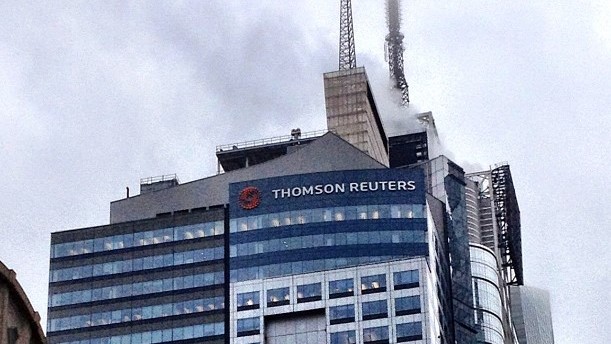
Last month, I wrote about the pushback by employees, shareholders and others against Thomson Reuters over its contracts to sell law enforcement data to U.S. Immigration and Customs Enforcement (ICE), primarily through two products: CLEAR (Consolidated Lead Evaluation and Reporting), which provides personal data from a variety of public and non-public sources, and license plate […]
Last month, I wrote about the pushback by employees, shareholders and others against Thomson Reuters over its contracts to sell law enforcement data to U.S. Immigration and Customs Enforcement (ICE), primarily through two products: CLEAR (Consolidated Lead Evaluation and Reporting), which provides personal data from a variety of public and non-public sources, and license plate recognition data, which contains more than 20 billion license plate scans.
In that article, I wrote about the campaign against these contracts conducted since 2019 by the British Columbia General Employees’ Union (BCGEU), which is a long-term minority investor in Thomson Reuters. The BCGEU has repeatedly urged Thomson Reuters’ shareholders to adopt resolutions that would require the company to assess the human rights risks related to the ICE contracts.
Now, ahead of Thomson Reuters’ June 10 annual meeting, BCGEU has again submitted a shareholder proposal that would require the company’s board of directors to commission an independent human rights impact assessment (HRIA) of how the company’s products are used by law enforcement and immigration authorities.
Ahead of the meeting, the BCGEU has released a new investor memo, dated May 2026 and addressed to institutional investors, laying out its case for why shareholders should vote in favor. The company’s board has recommended a vote against, arguing that its existing human rights due-diligence process already addresses the concerns the union raises.
(For background, see my two-part series on “The Legal Tech Giants Powering ICE”: Part 1, How Thomson Reuters and LexisNexis Helped Support America’s Immigration Surveillance Machine, and Part 2, The Pushback: Employees, Shareholders, Lawyers and the Fight Over May 31.)
What the Proposal Asks
The BCGEU’s resolution asks the board to commission an independent assessment evaluating the extent to which Thomson Reuters’ products may contribute to adverse human rights impacts when used by law enforcement and immigration agencies – including, critically, when those products are combined with other surveillance technologies.
The assessment, the proposal says, should address reasonably foreseeable risks arising from the aggregated or integrated use of surveillance tools, recommend measures to mitigate them, and be made public, subject to confidentiality and competitive considerations.
The products at issue are the same ones I detailed in my earlier reporting – the flagship CLEAR platform and its various law enforcement configurations and license-plate-reader data.
The memo says that there are active contracts potentially worth roughly $60 million as of April 2026 to supply such products to the Department of Homeland Security and ICE.
A Different Ask Than Before
As I mentioned above, this is not the BCGEU’s first proposal. It previously introduced human rights proposals at Thomson Reuters’ annual meetings in 2020 and 2021 asking the company to adopt the UN Guiding Principles on Business and Human Rights (UNGPs).
In 2022, the company adopted the UNGPs and committed to conducting human rights impact assessments and disclosing key findings.
In 2025, the union shifted its focus to AI governance, asking the company to extend the UNGP framework to its generative AI products. That proposal drew about 20 percent support from independent shareholders – lower than prior years. The decline was likely attributable to the company having already formally adopted the UNGPs.
This year’s proposal is different again. Rather than asking the company to adopt a framework it has already adopted, it targets what the union argues is a specific gap in how that framework has been applied – namely the risk created when Thomson Reuters’ data products are integrated into a wider surveillance ecosystem alongside tools from other vendors.
The Integration Argument
A core argument of the union’s investor memo is that Thomson Reuters’ products are no longer used in isolation but are “woven into a multi-platform surveillance ecosystem,” and that the compounding human rights risk of that integration has never been independently assessed.
The memo cites government contracting documents and reporting — including by Oakland Privacy, The New York Times, and the American Dragnet research project — that it says document how CLEAR can work with Palantir’s analytics platform in a system-to-system configuration.
The memo quotes legal scholar Sarah Lamdan’s description of a contract under which Thomson Reuters provides data and Palantir conducts the real-time analysis to determine targets. It also describes a newer Palantir application, Enhanced Lead Identification and Targeting (ELITE), that the memo says integrates Thomson Reuters data to map targets across geographic areas, and which it says has faced allegations of targeting people without criminal records.
In response to my previous article, Thomson Reuters sent an email stating flatly: “Palantir is not a customer of CLEAR. Our standard terms do not allow the redistribution of CLEAR data to third parties, and, after a contract is ended, they provide that no CLEAR data may be retained by any customer.” It later reiterated this in a blog post.
But the union is essentially arguing that customer status is not the issue; rather it is that interoperability requirements written into DHS contracts that create the integrated-surveillance risk it wants assessed.
The union’s memo makes parallel arguments about CLEAR’s sourcing of real-time location data from the surveillance vendor PenLink, citing a 2025 SEC privacy impact assessment, and about the 2017 integration of license-plate-recognition data from Vigilant, a Motorola company, into the CLEAR platform.
The Company’s Position
In the management proxy circular for the annual meeting (starting at page A-6), Thomson Reuters’ board has recommended that shareholders vote against the proposal. In its statement urging that vote it makes two arguments: first, that an additional independent assessment would be “duplicative and an inefficient use of shareholder resources,” and second, that its existing human rights governance framework already addresses what the union is asking for.
The board describes a human rights assessment process that has expanded considerably since 2022. The company says it has management-level accountability through a Human Rights Steering Committee co-chaired by its chief legal officer and chief people officer, that it formally aligned with the UN Guiding Principles in 2022, and that it conducts a company-wide human rights saliency and impact assessment (HRSA/HRIA) every three years.
It states that it completed its second such assessment in 2025 – covering its global operations, services and products, “including our investigative solutions” – working with the same specialized consultancy that conducted the first assessment, along with outside ESG legal counsel.
That engagement, the board says, produced a three-year roadmap overseen by the steering committee. In addition, further assessment work will continue in 2026 and beyond, the company says, and it expects to disclose key findings from the 2025 assessment on its website “in line with previous assessments.”
The board also pushes back directly on the union’s core arguments. “Our investigative solutions, including CLEAR, are not surveillance tools,” the statement says, characterizing them instead as investigative solutions sold to law enforcement, and describing the underlying data — “such as court and property records” — as “publicly available or licensable directly from aggregators.”
As to the controls the union wants documented, the company says that CLEAR is supported by a credentialing and compliance program that “validates permissible use,” that the company performs “routine customer audits,” monitors for suspicious activity, and requires a compliance acknowledgment at each customer login.
Where misuse is detected, it says, it will act “up to and including terminating customer accounts.” It states that use of the products must comply with applicable laws and that the solutions “may not be used as a factor in establishing a consumer’s eligibility for credit, insurance, employment, or for any other purpose governed under the Fair Credit Reporting Act.”
The company adds that it does not limit its analysis to domestic law, and that where an end-user’s use complies with domestic law but “may run counter to” international human rights norms, “the matter would be thoroughly investigated and actioned as appropriate.”
Finally, the company ties its products to public safety, saying they support investigations into “child exploitation, human trafficking, narcotics and weapons trafficking and financial crime,” and pointing to an internal “Everyday Heroes” program that highlights cases in which its products helped find abducted children and stop exploitation.
“We do not believe that providing investigative solutions to law enforcement agencies for these purposes is inconsistent with our human rights commitments,” the statement says.
The statement does not directly address the union’s central argument that contractual interoperability requirements and system-to-system configurations create risk beyond any single product.
I have asked Thomson Reuters for any additional comment on the new memo and the upcoming vote, beyond the board’s published recommendation, and will update this post with any response.
The Backdrop Has Shifted
The union’s memo argues that changes in the landscape around ICE enforcement have given greater urgency to this year’s proposal.
One is simply the enforcement environment, especially in the wake of “Operation Metro Surge” — the intensified federal immigration enforcement in the Minneapolis–St. Paul area over the winter of 2025–2026.
Another is the dismantling of DHS oversight offices, including the reported gutting of the Office for Civil Rights and Civil Liberties and the shuttering of the Office of the Immigration Detention Ombudsman in May 2026.
As government oversight contracts, the union argues, the burden of human rights diligence shifts onto contractors — and onto their investors.
Even so, it bears repeating, as it did in my earlier coverage, that the practical leverage of any shareholder vote here is structurally limited. With Woodbridge controlling roughly 68 percent of the company, a proposal opposed by the board and the controlling shareholder cannot pass on the strength of independent votes alone.
That makes the June 10 result less a referendum than a measurement. The question it could answer is whether independent investors believe Thomson Reuters’ existing disclosures and assessments have kept pace with the risk environment in which the company now operates.