
Cheap clicks? Bo Royal pulled data from PI, criminal defense and bankruptcy ad campaigns to find out which ads actually work. Here’s his advice on building a law firm PPC strategy that drives more signed cases, not more clicks.
The post Building a Law Firm PPC Strategy That Actually Signs Cases appeared first on Articles, Tips and Tech for Law Firms and Lawyers.
Bo Royal analyzed the data from plaintiff-side law firm ad campaigns to figure out what was driving cases and not just clicks. His findings may change how you think about your law firm’s PPC strategy.
Highlights
- Stop managing your legal marketing and advertising campaigns by cost per lead alone. A low CPL in competitive fields like criminal defense frequently masks an unsustainably high cost per signed case.
- Incorporate Google Local Service Ads into your broader law firm PPC strategy. LSAs consistently generate higher-intent prospects at a lower overall acquisition cost.
- Do not deploy an aggressive PPC strategy until you have airtight data that connects every single marketing dollar to a signed retainer. Never scale based on gut feelings — especially if you juggle multiple practice areas like PI and bankruptcy, where conversion dynamics are different.
The CPL Trap: Lessons From Plaintiff-Side Law Firm Advertising Campaigns
As I’ve written before, I don’t believe more leads fix legal marketing issues. They end up becoming expensive proof that something is wrong.
So our team pulled the books on a few plaintiff-side law firms we managed in 2025. They were split between three practice areas and $3.3 million in combined Google Ads and Local Service Ads (LSA) spend. Our goal was to answer what drives signed cases.
Here are the key things we found in our law firm PPC data analysis:
1. The Cheapest Leads Are Almost Always the Most Expensive
Look at three practice areas side by side:
| Practice Area | Cost / Lead | Lead → Case | Cost / Signed Case |
|---|---|---|---|
| Personal Injury (MVA) | $284 | 7% | $468 |
| Criminal Defense | $60 | 2% | $659 |
| Bankruptcy | $201 | 10% | $192 |
Criminal defense has the cheapest leads in the entire dataset: $60 a piece. If you ran your firm on cost per lead alone, you’d double down here tomorrow.
But you’d also lose money because only 2% of those leads sign. The real cost per case in such a scenario came up to $659. This is more expensive than personal injury, and more than three times what bankruptcy pays per signed case.
Bankruptcy, on the other hand, is the opposite story. It has a higher CPL ($201), but a 10% conversion rate drags the cost per case down to $192. If you run a bankruptcy practice, PPC is probably the most efficient acquisition channel you have.
The point isn’t that one practice area is “better.” The point is that cost per lead is a vanity metric. If your agency is reporting CPL, they’re optimizing for a legal KPI that may only have a loose relationship to revenue.
The right number worth scaling on is your cost per signed case, or CAC (case/client acquisition cost).
2. Local Service Ads Quietly Outperform Google Ads
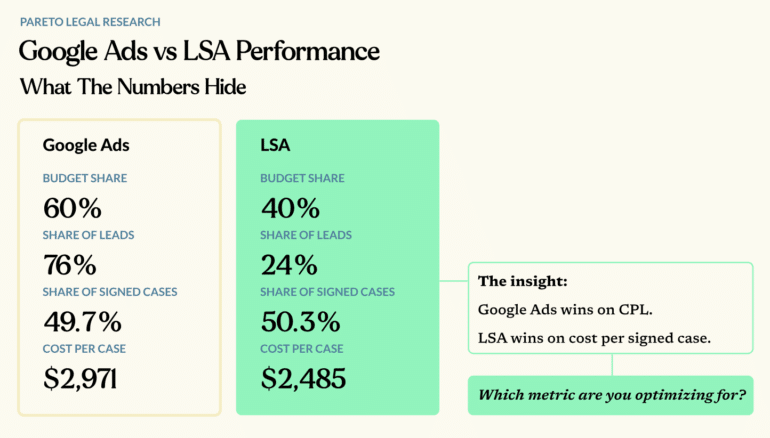
Across the firms we manage, Google Ads got 60% of the budget and produced 76% of the leads. LSA got 40% of the budget and produced 24% of the leads.
If you stopped reading there, you’d change your law firm PPC strategy tomorrow to reduce the LSA spend. Google Ads is “winning” on volume and CPL. But keep reading:
| Channel | Share of Budget | Share of Signed Cases | Case Acquisition Cost |
|---|---|---|---|
| Google Ads | 60% | 49.7% | $2,971 |
| LSA | 40% | 50.3% | $2,485 |
LSA gets less of the budget, generates fewer leads at a higher CPL. Yet it still produces more signed cases at a lower cost per case. The leads are simply higher intent.
The thing is, when someone calls through a Google Screened badge, they’ve already pre-qualified themselves as a serious prospect. Google Ads casts a wider net and brings in more tire-kickers along with the real cases.
If your agency reports CPL as its headline metric, they might keep moving budget toward “efficient” Google Ads campaigns and away from the channel that’s quietly producing half your retainers.
Tip: If you’re spending on both, ask your team to pull a 12-month report showing CAC by channel, not CPL. Then have a conversation about whether the budget split actually matches the case split.
3. The Missing Metric: Tracking Real Law Firm Marketing ROI
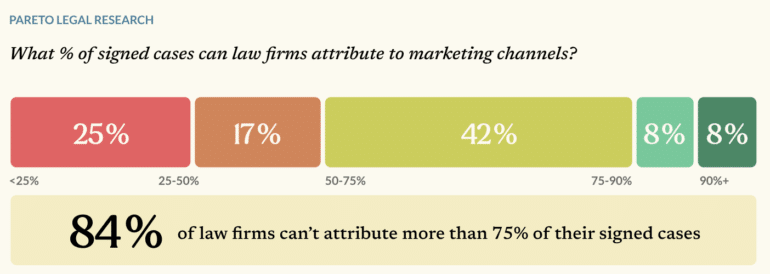
Most law firms are making these decisions blindly. Here’s the finding that should bother firm owners reading this. Just 25% of firms could attribute fewer than a quarter of their signed matters to a marketing channel. Another 42% landed somewhere between 50% and 75%. Only 16% crossed the 75% line.
This means 84% of law firms can’t say, with confidence, where three out of four of their signed cases came from. That means 84% are making budget decisions on a lot of guesswork, and may be scaling losers.
The fix is unsexy but simple: call tracking.
We use CallRail and form tracking that posts back to your case management system, a single intake script with a clean “how did you hear about us” field, and someone on your team whose job it is to reconcile the data weekly.
If you cannot pull a report tomorrow that shows you the cost per signed case by channel, let the attribution be the first thing you build.
Remember, until you can see it, more spending is just louder guessing.
What To Actually Do This Summer
Paid search is among the top three legal marketing channels. Indeed, larger firms name it as their top acquisition channel. Hopefully, this data puts into perspective that you ought to stop running your marketing on CPL.
My recommendations:
- Pull data on the cost per signed case by channel for the last 12 months. If your team can’t produce it, that’s the first project.
- Benchmark against your practice area, not your gut. If you run multiple practice areas, try to segment and find your highest converting one.
- Pressure-test your LSA budget. If you’re under 30% LSA, there is probably more efficient case volume on the table.
- Fix attribution before you scale anything. A bad budget decision at $10K a month is annoying. The same decision at $100K a month is existential.
The firms that grow profitably in 2026 won’t be the ones with the biggest ad budgets. They’ll be the ones who can answer a simple question on a Tuesday afternoon: Which dollar of spend produced which signed case last month?
Image © iStockPhoto.com.

Sign up for Attorney at Work’s daily practice tips newsletter here and subscribe to our podcast, Attorney at Work Today.