
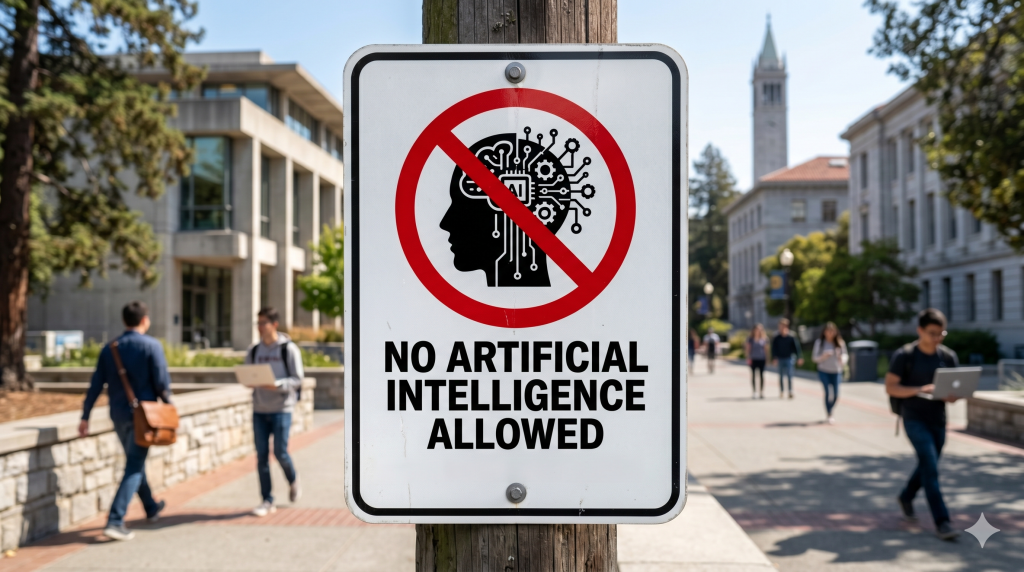
UC Berkeley School of Law has adopted one of the most restrictive student AI policies of any top law school, barring the use of generative AI for nearly every step of producing graded work — and prohibiting it outright in any exam. The policy takes effect this summer. The rule, which the school released last […]
UC Berkeley School of Law has adopted one of the most restrictive student AI policies of any top law school, barring the use of generative AI for nearly every step of producing graded work — and prohibiting it outright in any exam. The policy takes effect this summer.
The rule, which the school released last week, forbids the use of AI for “conceptualizing, outlining, drafting, revising, translating, or editing any work submitted for credit.” It also bars students from uploading course materials — assignments, readings, slides, class recordings — into generative AI systems, and limits permitted research use to the narrow task of identifying sources such as cases, statutes or secondary materials.
Students remain responsible for verifying those sources, and the policy warns that citations to nonexistent authorities “will raise a presumption of prohibited AI use.”
The policy enumerates banned activities with unusual specificity. Asking a tool to brainstorm a thesis is “prohibited conceptualizing.” Proposing an outline is “prohibited outlining.” Summarizing a legal rule for a paper is “prohibited drafting.” Flagging repetitive passages is “prohibited revising.” Correcting grammar is “prohibited editing.”
“Thinking remains the sine qua non of good lawyering (and of a quality legal education),” the policy states. “This policy seeks to ensure that our courses focus on requisite cognitive skills by default.”
Professor Chris Hoofnagle, faculty director of the Berkeley Center for Law & Technology and a principal author of the rule, told Business Insider that the school concluded its 2023 AI policy had been “too liberal” given how far generative models had advanced.
A model, he said, “can, in effect, write a research paper soup to nuts,” and that capability “required us to rethink students’ reliance on them.”
The Case for the Ban
In a series of posts on X, Hoofnagle links the need for the policy to the value proposition of the profession itself. “We want students to develop their own analytical judgment, otherwise they just outsource it to AI,” he wrote.
Putting it more bluntly, he wrote: “Here’s a key idea: In the classroom, we don’t want students to write the best possible paper, but rather the best possible paper that the student is capable of.”
According to the San Francisco Chronicle, Hoofnagle brought the proposal to faculty after seeing an uptick in submissions with dubious legal reasoning, and the school has converted a number of take-home exams to proctored, in-person formats run on lockdown software.
“We found examples where students announced “I’ve found a solution to X while conversing with ChatGPT,” Hoofnagle wrote on X. “But that solution was not theirs – it was already reflected elsewhere in the literature, conceptualized by someone else.”
Hoofnagle said that students remain free to use AI “to prepare for class, to self-tutor, and so on.”
The policy also allows instructors to provide leeway. “Instructors have the discretion to deviate from this default rule, provided that they do so in writing and with appropriate notice and require students to disclose any authorized AI use,” it states.
Students who are unsure if a particular use is permitted “must ask their instructor and receive clarification in writing before engaging in the use.”
AI As A Core Competency
Obviously, there is some logic to putting guardrails around law students’ use of AI. A first-year law student who never learns to read and analyze a case unaided by AI is poorly trained for the remainder of law school, let alone legal practice.
The problem, however, is that this policy seems to treat AI fluency as something students can acquire later, somewhere else — wherever that “somewhere else” may be, and possibly at greater risk to their future clients.
Hoofnagle does not dispute that AI skills matter. He told Business Insider that the expectation from law firms is that students graduate AI-proficient, and that students are themselves requesting these courses after learning during their summer internships that firms already use AI extensively.
“Don’t lawyers need to learn AI?” he wrote on X. “Of course. And we have AI-specific courses focused on those skills.
“But when it comes to the basics, particularly in 1L, we need students to do the work, lest they never develop the ability to judge for themselves.”
That would make more sense to me if the policy were limited to first-year students. But the fact is that students must also learn the judgment skills required by AI. That is not just the ability to use AI, but also to supervise it – to spot the hallucinated citation, to recognize when an AI outline has buried the strongest argument, to feel where a generated draft is confidently wrong.
The only way to build that “judgment muscle” is to use it, and the best and safest place to use it is in law school, before AI mistakes can harm actual clients.
A rule that bars AI from “conceptualizing, outlining, drafting, revising, translating, or editing” any graded work removes precisely the supervised, low-stakes setting – the classroom – where a student could practice catching an AI’s mistakes under an instructor’s eye and never harm an actual client when the AI goes wrong.
The danger is that students do not develop critical AI skills until later, and then possibly without supervision, such as in a summer associate role or as a first-year lawyer, where the AI output they fail to scrutinize is attached to an actual client matter and the cost of a missed hallucination is no longer simply a grade.
I get it. A 1L who never learns to read a case without the aid of AI is unprepared to practice law. There is a real risk that overuse of AI could cause students to effectively skip the foundational essentials of a legal education.
But in creating a blanket ban across all three years of law school, the rule seems misguidedly overbroad. Could not schools teach both analytical and AI skills hand-in-hand? An assignment that asks a student to critique and correct a deliberately flawed AI-generated brief simultaneously tests judgment and builds AI competency.
The Bottom Line
Hoofnagle concedes the rule has loopholes and describes policing AI as a “Sisyphean task.” He notes that standard searches on Lexis and Westlaw now surface LLM-generated summaries, and that search engines are layering AI over ordinary results.
“There is no kind of clean answer for it,” he told Business Insider, conceding the school “obviously can’t ban search.”
Berkeley is not alone in tightening up on AI use. Princeton recently made in-person proctoring universal for the first time in 133 years, citing AI among the reasons. And given Berkeley’s standing and its history as an early mover on legal-tech education, still other schools will likely read this rule closely, and perhaps even copy it.
But the difficult question is whether schools can develop competency in AI even as they broadly restrict its use.
The policy’s own author acknowledges that firms now expect AI-proficient graduates, that students are clamoring to learn AI skills, that many common tools, including Lexis and Westlaw, already incorporate AI, and that there is “no kind of clean answer” for any of it.
If AI competency is becoming as essential to lawyering as legal research or writing, and if that competency is fundamentally about the judgment to supervise the tool rather than simply the ability to operate it, then law school is exactly where it should be learned
Law school derisks the AI-learning process, letting it happen under supervision, on low-stakes work, where a missed hallucination may cost a grade, but does not harm a client.
A policy that removes AI from the one setting built for formative mistakes does not eliminate the possibility of mistakes – it simply defers them to the setting where they become more costly.
The question, in short, is whether, in trying to preserve the thinking that good lawyering requires, Berkeley is failing to teach the very skill the profession is now demanding its graduates already have.