How do you keep good people when everyone works from home?” Casey Meraz tells what worked (and what did not) for his fully remote company, a new INC Best Workplace designee.
The post Law Firm Employee Retention: What a Fully Remote Agency Can Teach You About Keeping Good People appeared first on Articles, Tips and Tech for Law Firms and Lawyers.
Should you run your firm more like this “Inc. Best Workplace” marketing agency? Juris Legal CEO Casey Meraz shares ideas you can use to help solve your law firm’s employee retention problem.
Table of contents
What We Learned About Keeping Good People
Attorneys often ask me about SEO and marketing, but lately, they’ve been asking me about something very different … and a little more meta: “How do you keep good people when everyone works from home?”
It’s a fair question, and I’ve had time to think through it critically. I’m the founder of Juris Digital, a fully remote digital marketing agency. We were just named a 2026 Inc. Best Workplace, and the designation really echoes what I’m seeing here in real time. Our team members are posting unprompted messages in Slack on their three-year anniversaries, thanking the team for a positive work environment. People are genuinely happy.
I’m not telling you this to brag or flex. In fact, five years ago, we had no idea how to do any of this, and most of what we tried didn’t work initially.
The truth is, law firms and agencies struggle with the same retention problem. Your best associates don’t leave for money alone. They leave because nobody noticed their work, they couldn’t see a future, and the law firm culture was whatever happened in the absence of one. Remote work doesn’t create those problems. But it does remove the office camouflage that used to hide them.
What Failed First
Here’s what we tried, what failed, and the few things that actually worked for us.
Software-as-culture
We bought 15Five, a check-in tool intended to keep everyone connected and heard. As with most new, shiny objects I find, we were very excited to see the impact just rolling out a piece of software would have on team culture.
We ran it for a couple of years and quietly killed it.
The weekly check-ins became homework for our team. People filled them out because they had to, managers skimmed them, and nothing changed.
The lesson wasn’t that we were leveraging the “wrong tool.” It was that people didn’t want to be checked in on. They wanted to know where their career was going.
We eventually replaced it with a platform built around goals and career development. Adoption took care of itself because it helped answer their fundamental questions about where they were headed professionally.
We Tried Forced Fun
When we launched virtual happy hours, they were rough. Our team would post the Zoom link and then literally ask people to react with an emoji if they planned to skip.
If we had to beg or force attendance, we questioned whether the event itself was the issue. Remote social time competes directly with client work and family time, and a generic “hang out on video” doesn’t stand a chance against that.
Soft Commitments
In retrospect, this one probably cost us the most.
In a remote company, it’s easy to build what I started calling a “soft commitment culture.” This is where problems get identified in meetings, everyone nods, and nothing has an owner or a due date.
Your best people notice this before you do. Nothing burns out an A-player faster than watching the same problem get discussed for the third month in a row.
Unreachable Incentives
When we first built our bonus structure, I set thresholds like a 99% client satisfaction score. It matched our goals, but a bar that high reads as “you will never get this bonus,” which is worse than no bonus at all. So, we rebuilt it with tiered targets people could actually hit.
What Actually Moves Employee Retention?
1. Weekly Recognition with Names and Specifics
We use a tool called Bonusly that lets anyone on the team give anyone else points (redeemable for real rewards, like gift cards) attached to a public shoutout.
The shoutout gets amplified. Every week, our team posts an MVP board in our watercooler Slack channel to celebrate the person who earned the most recognition from their peers through the Bonusly platform. There’s also a weekly memo that names one standout person and specifically describes what they did. Not “Great job, Sarah.” It’s more like: “K has been the steady force behind the Green POD, from client comms to making sure nothing slips through the cracks.”
Generic praise is just noise. Specificity tells someone their actual work is visible and valuable. It’s the whole game.
In an office, people get that visibility almost accidentally. In a remote environment, you have to build the machine and system that produces it. A law firm version of this recognition system costs nothing.
A weekly partner email that names one associate and one staff member, specifying exactly what they did well, would put you ahead of 90% of firms.
But to be clear, innovation is about more than the tools a company uses—it’s about cultivating an environment where creative thinking and improvement are encouraged.
2. Pay People for the Outcome You Say You Value
Every firm says they value client relationships. Almost nobody pays for them. We restructured bonuses so our client service teams earn them for keeping clients: retention rate, satisfaction scores and churn. Then we added something softer that mattered just as much: we publicly celebrate the people who kept their clients, the same way most shops only celebrate the people who land new ones.
Watch where the applause goes in your firm. If origination gets a party and retention gets silence, your people will optimize for exactly that.
(Read “Your Law Firm’s Partner Compensation Plan Is Sabotaging Your Succession” by Brenda Barns and “Understanding Law Firm Bonuses: A Simpler Bonus Structure for Associates, Paralegals and You” by Brooke Lively on Attorney at Work.)
3. One Real In-person Gathering a Year
We hold an annual summit, all expenses paid, with the destination announced at an all-hands meeting like it’s a reveal. People talk about it for months before and after.
I used to think we needed constant virtual events to replace the office. I think I was wrong. One genuinely great in-person week beats 50 mediocre Zoom socials. We still do monthly virtual happy hours, but we’ve changed the format. We play actual games (Jackbox, prizes, trash talk) instead of forcing unstructured hangouts.
When you give people something to do together, attendance stops being a chore.
4. Show People the Next Rung
We promote from within, and we announce it loudly, with the reasons.
We rebuilt every job description with clear performance metrics so people know exactly what their role requires and what the next one looks like. Ambiguity about advancement is a resignation letter being slowly drafted. That’s true for a fifth-year associate wondering about partnership, and it’s true for an SEO specialist wondering what’s next.
5. Table Stakes are Still Table Stakes
The benefits matter. Unlimited time off that people actually use, fully paid health insurance and co-working access for people who want it are standard.
None of this is innovative. It just removes reasons to interview elsewhere, so the other stuff can work.
Our fabulous COO and President, Leann Pickard, is the real brains of this operation. She launches and runs most of these initiatives, and she’d tell you the unglamorous part is the consistency:
“A strong workplace culture does not happen by accident. It takes consistency, listening, and a real commitment to making people feel seen and supported. The recognition programs and the summit get the attention, but what actually keeps people is that we do these things every single week, whether it’s a good month or a hard one.”
Employee Retention Isn’t a Perk Problem
We failed with a check-in tool, awkward happy hours, vague accountability, and impossible bonus targets before we figured out what worked. The needle moved with specific public recognition, incentives that aligned with keeping clients, one great in-person event, visible career paths, and benefits that remove excuses.
None of it requires being remote, being an agency, or buying software. But better law firm employee retention does depend on the decision to keep your people with a system you run on purpose.
Bonusly Rewards Platform FAQs
Bonusly is an employee recognition platform that allows coworkers to publicly recognize one another by giving points along with a message describing what the recipient did well. Employees can redeem accumulated points for rewards such as gift cards and charitable donations.
Each employee receives a monthly budget of points to give to teammates. When someone receives points, the recognition is shared publicly, helping great work become more visible across the organization.
Companies use Bonusly to improve employee engagement, increase recognition, reinforce company values, and create a culture where employees feel appreciated for their contributions.
Yes. Bonusly helps remote and hybrid teams create visibility and recognition that might otherwise happen informally in an office. Public shoutouts can help employees feel connected, valued, and acknowledged, regardless of location.
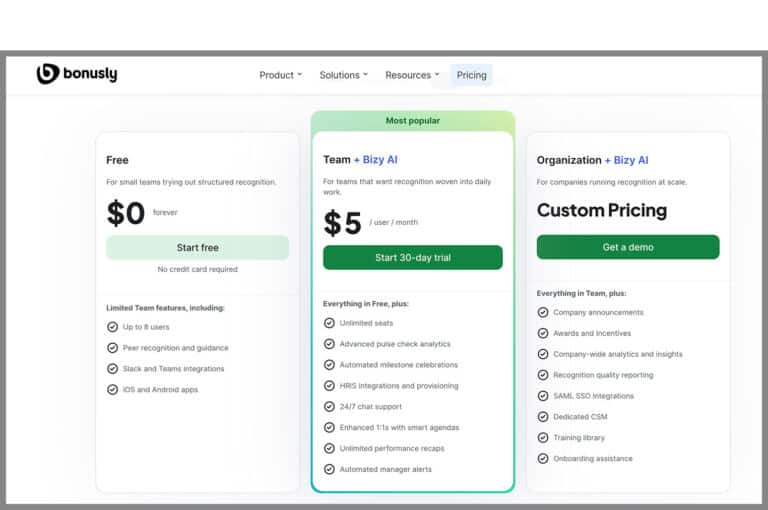
Bonusly is free to try for up to 8 users. For more features and unlimited users, the monthly fee is $5 per user. Custom options are also available.