
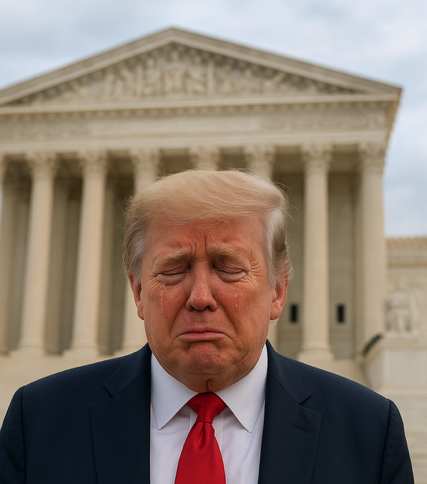
The Supreme Court isn’t in the business of granting rehearings and it’s very much not in the business of changing its decisions upon rehearings. But Donald Trump has made a practice of refusing to take no for an answer and, in that spirit, he asked the Supreme Court for a rehearing to get out of the $5 million he owes E. Jean Carroll for defamation related to sexually assaulting her in the past. Which is not to be confused with the $83 million Trump owes E. Jean Carroll for defamation related to sexually assaulting her in the past… in a separate lawsuit. The Supreme Court still hasn’t addressed the latter.
Rehearings require, at a minimum, some intervening circumstance of a substantial or controlling effect or some other substantial grounds not previously presented. Donald Trump’s lawyers told the Court they definitely had one! It was just in a brief they hadn’t bothered to write yet.
Anyway, the Court declined.
Trump’s request sought a do-over on his cert petition. As rehearing requests go, those aren’t as much of a longshot as attempting to reverse a ruling (which Trump also promised to seek in the birthright citizenship case before deciding to just assert that he won anyway). Professor Steve Vladeck pointed out that the Court last granted a cert denial rehearing in August 2018. Which is still eight years ago, but compared to rehearing a pleanry ruling — which hasn’t happened since the 50s — cert rehearings are positively common. In any event, the petitioners still need to offer up some compelling reason for the Supreme Court to change its mind. In this case, Trump’s lawyers offered… this:
Rehearing is warranted because President Trump will imminently file a petition for a writ of certiorari in Carroll v. Trump, No. 24-644 (2d Cir.) (“Carroll I“), which will present vital questions concerning Presidential immunity for official statements.
“Will imminently” forms the perfect legal argument complement to an administration infamous for boasting about “the concepts of a plan.”
The merits of the petition boiled down to a hope and a prayer that the president might win a future case. That upcoming case — the $83.3 million petition that Sullivan & Cromwell slapped its reputation on, which is actually “Carroll I” despite being the one down the road — asks whether gratuitous defamatory claims should enjoy bootstrapped official policy gravitas just because Trump spoke about nuclear proliferation at the same press conference. Meanwhile, this case is about comments made when Trump was decidedly NOT the president and therefore have no colorable official act protection. But, as Trump’s lawyer unsuccessfully argued, this case included additional testimony dating back to Trump’s first presidency, so — if you squint hard enough — then the later case would be a future intervening event.
Maybe?
In Trump v. United States, the Supreme Court’s conservatives turned the presidency into a nearly impenetrable cocoon of immunity for anything even in the ballpark of an official act. The part of that decision that even Amy Coney Barrett balked at joining went so far as to expand that immunity to prevent even introducing “official acts” as evidence in cases that have nothing to do with official acts. Like, for example, stuff that Trump may have done in 2019 when he was president to illuminate defamation in 2022 when he was not.
And the Supreme Court really might not want to see its criminal immunity case ported onto civil litigation.
The Supreme Court knew full well that the later case could implicate this one. They didn’t need a motion to remind them. And they made clear that they did not care.
Earlier: Trump Demands SCOTUS Reverse Birthright Red Card
Trump’s Howler Monkeys Attack Carroll’s Lawyer
S&C’s Bob Giuffra Put His Name On The Trump SCOTUS Petition He Was Going To Stay Away From
The post Supreme Court Kills Trump’s E. Jean Carroll Rehearing Request appeared first on Above the Law.
The Supreme Court isn’t in the business of granting rehearings and it’s very much not in the business of changing its decisions upon rehearings. But Donald Trump has made a practice of refusing to take no for an answer and, in that spirit, he asked the Supreme Court for a rehearing to get out of the $5 million he owes E. Jean Carroll for defamation related to sexually assaulting her in the past. Which is not to be confused with the $83 million Trump owes E. Jean Carroll for defamation related to sexually assaulting her in the past… in a separate lawsuit. The Supreme Court still hasn’t addressed the latter.
Rehearings require, at a minimum, some intervening circumstance of a substantial or controlling effect or some other substantial grounds not previously presented. Donald Trump’s lawyers told the Court they definitely had one! It was just in a brief they hadn’t bothered to write yet.
Anyway, the Court declined.
Trump’s request sought a do-over on his cert petition. As rehearing requests go, those aren’t as much of a longshot as attempting to reverse a ruling (which Trump also promised to seek in the birthright citizenship case before deciding to just assert that he won anyway). Professor Steve Vladeck pointed out that the Court last granted a cert denial rehearing in August 2018. Which is still eight years ago, but compared to rehearing a pleanry ruling — which hasn’t happened since the 50s — cert rehearings are positively common. In any event, the petitioners still need to offer up some compelling reason for the Supreme Court to change its mind. In this case, Trump’s lawyers offered… this:
Rehearing is warranted because President Trump will imminently file a petition for a writ of certiorari in Carroll v. Trump, No. 24-644 (2d Cir.) (“Carroll I“), which will present vital questions concerning Presidential immunity for official statements.
“Will imminently” forms the perfect legal argument complement to an administration infamous for boasting about “the concepts of a plan.”
The merits of the petition boiled down to a hope and a prayer that the president might win a future case. That upcoming case — the $83.3 million petition that Sullivan & Cromwell slapped its reputation on, which is actually “Carroll I” despite being the one down the road — asks whether gratuitous defamatory claims should enjoy bootstrapped official policy gravitas just because Trump spoke about nuclear proliferation at the same press conference. Meanwhile, this case is about comments made when Trump was decidedly NOT the president and therefore have no colorable official act protection. But, as Trump’s lawyer unsuccessfully argued, this case included additional testimony dating back to Trump’s first presidency, so — if you squint hard enough — then the later case would be a future intervening event.
Maybe?
In Trump v. United States, the Supreme Court’s conservatives turned the presidency into a nearly impenetrable cocoon of immunity for anything even in the ballpark of an official act. The part of that decision that even Amy Coney Barrett balked at joining went so far as to expand that immunity to prevent even introducing “official acts” as evidence in cases that have nothing to do with official acts. Like, for example, stuff that Trump may have done in 2019 when he was president to illuminate defamation in 2022 when he was not.
And the Supreme Court really might not want to see its criminal immunity case ported onto civil litigation.
The Supreme Court knew full well that the later case could implicate this one. They didn’t need a motion to remind them. And they made clear that they did not care.
Earlier: Trump Demands SCOTUS Reverse Birthright Red Card
Trump’s Howler Monkeys Attack Carroll’s Lawyer
S&C’s Bob Giuffra Put His Name On The Trump SCOTUS Petition He Was Going To Stay Away From