

Ed. note: This is the final article in a three-part series from Litera exploring how law firms can turn AI-driven efficiency into sustainable growth. The first installment made the case for unifying the practice and business of law. The second examined how trusted Legal AI creates the quality clients rely on and the accuracy the firm can prove.
Law firms are already proving that AI can save significant time. The important question is what happens to that time.
AI can make the work itself faster and better. It can help lawyers draft, review diligence, and close matters with more speed and confidence. But saving time on the work is only part of the equation. Those hours do not automatically become new matters, stronger client relationships, or better economics. Someone still has to know where the next opportunity is, which relationships need attention, what experience will matter in a pitch, and how to scope and price the work before margin starts to slip.
That is the business of law. And in too many firms, those decisions are still being made from memory, instinct, and data scattered across disconnected systems.
The AI Efficiency Trap, Revisited
The first article in this series described the AI efficiency trap. Firms can become materially more efficient without becoming more profitable or creating new growth. If AI reduces the time required to deliver legal work, firms need an equally deliberate strategy for what they do with the capacity it creates.
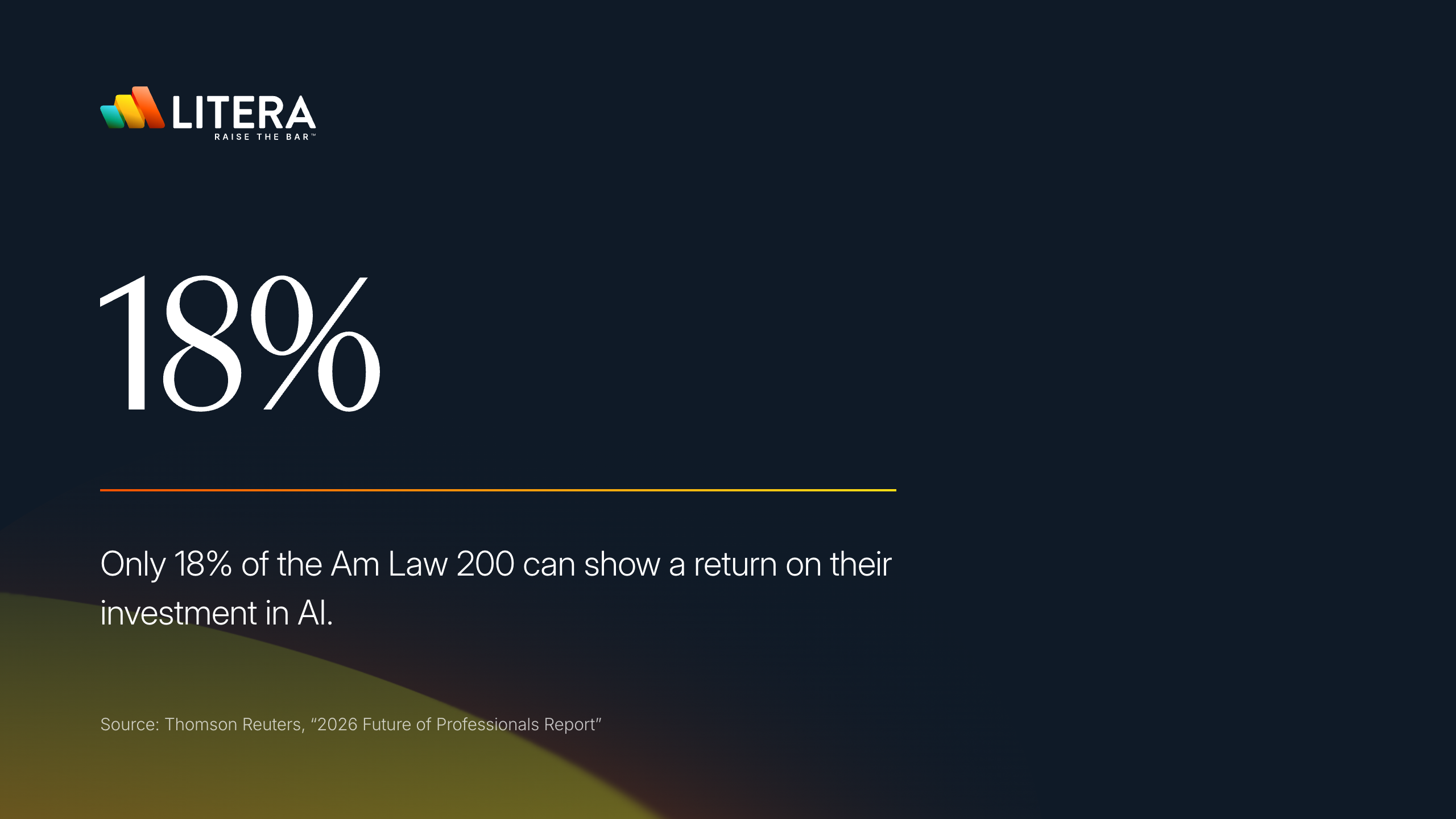
That tension came through clearly in my conversations with firm leaders at ILTACON in Nashville. AI is already saving meaningful time across legal workflows, yet recent research suggests only 18% of firms can demonstrate a return on that investment. That gap is important. Saving hours is one thing. Converting that capacity into better client outcomes, deeper relationships, new work, and stronger economics is another.
Those outcomes do not happen automatically. They depend on whether a firm can connect what it already knows about its clients, relationships, experience, matters, and financial performance and put that intelligence in front of the people making commercial decisions.
So, the question is no longer simply how to make lawyers faster. It is how to make the firm’s intelligence work as hard as its lawyers do.
Where Firm Growth Stalls
Ask how quickly a firm can answer a client’s question about its most relevant experience, and the answer is often: not quick enough. Pulling that answer together can take hours and still require the familiar “pardon the interruption” email asking who has done similar work. A business development team may see signs that a client relationship is cooling but struggle to get that insight to the right partner at the right time. A pricing discussion may happen without a clear view of how comparable matters were scoped, priced, or ultimately realized. Marketing may see engagement without enough context around the relationship, client, or experience behind it.
In most cases, the intelligence already exists. The problem is that it sits across different systems, teams, and workflows, making it difficult to use when a commercial decision is actually being made.
Five Outcomes from Relationship to Revenue
Turning AI-driven efficiency into commercial value requires connected business outcomes, not another collection of disconnected tools. I think about that in five parts:
⒈ Know where to grow and who can help get you there. For many firms, some of the best growth opportunities are already inside the existing client base. Relationship intelligence, whitespace analysis, and relevant signals can help identify where relationships are strong, where they may be weakening, and where there may be unmet client needs. The outcome: lawyers can focus their time on the right opportunities with the right relationships behind them.
⒉ Back every pursuit with proof, not memory. When a client asks about the firm’s experience, the answer should not depend on who happens to remember a similar matter. Connected experience and expertise data can put the right matters, credentials, and people behind a pitch much faster. The outcome: every pursuit is grounded in the firm’s actual track record.
⒊ Connect engagement to client development. Marketing becomes more valuable when campaign, event, and digital engagement signals are connected to the same client and relationship intelligence used by business development. That gives firms a clearer view of who is engaging, what they are engaging with, and where that activity may warrant action. The outcome: marketing activity becomes more directly connected to measurable pipeline and client growth.
⒋ Make sure growth is profitable. Firms cannot respond to AI-driven efficiency by simply discounting faster. They need better visibility into how comparable matters were scoped, staffed, priced, delivered, and ultimately realized. That intelligence should inform the commercial decision before the matter begins, not months later when the margin has already been lost. The outcome: more revenue becomes profitable revenue.
⒌ Turn intelligence into action. Giving lawyers another dashboard is not the same thing as helping them make a better decision. The opportunity for Legal AI is to bring the firm’s relationship, experience, and commercial intelligence into the workflows where lawyers and business professionals are already working and help them understand what to do next. The outcome: firm intelligence becomes actionable, not simply accessible.
None of these outcomes is especially powerful in isolation. The real advantage comes when the intelligence created across the business of law connects with the workflows where legal work is actually being performed.
When the Practice and Business of Law Share Intelligence
This is where the opportunity gets more interesting. When the practice and business of law can draw from the same intelligence, what the firm learns in one workflow can improve the next. Experience from a complex matter can strengthen the next pitch. Relationship signals can help partners decide where to invest their time. What the firm learns from completed matters can improve how the next engagement is scoped, staffed, and priced.

When the practice of law and the business of law share intelligence, efficiency can become opportunity, and opportunity can become growth. That is the shift firms should be working toward. Not simply adding more AI tools but making the intelligence they already have easier to use in the decisions that drive growth.
Litera is building toward that model by connecting decades of legal workflow experience with each firm’s own relationship, experience, matter, and financial intelligence, and making it accessible through the tools where lawyers and business professionals already work. The goal is not another dashboard. It is better decisions.
The Firms That Will Define the Next Decade
The first article in this series examined the AI efficiency trap. The second focused on how firms create trusted value through the practice of law. This final piece completes the equation: what firms do with the capacity AI creates and how they translate it into stronger relationships, better commercial decisions, and sustainable growth.
The return on AI cannot be measured in hours saved alone. Efficiency creates capacity. Relationship intelligence helps firms find and pursue the right opportunities. Commercial intelligence helps ensure the work they win is scoped, priced, and delivered with the economics in mind.
That is how AI moves from a productivity story to a growth story.
That is what it means to Raise The Bar™.
Explore how Litera unifies the practice and business of law. See how it all connects.

Grant Hewlett, Vice President, Product-Firm Intelligence, Litera.
Grant is a legal strategy and operations executive who works with leading global law firms, nationally recognized practices, premier regional boutiques, and major corporate legal teams to improve financial performance and operational execution. His work focuses on solving underperformance, aligning strategy with delivery, and building operating models that enhance profitability, scalability, and long-term organizational health.
The post Saving Time Is Not The Win. Turning It Into Growth Is. appeared first on Above the Law.
Ed. note: This is the final article in a three-part series from Litera exploring how law firms can turn AI-driven efficiency into sustainable growth. The first installment made the case for unifying the practice and business of law. The second examined how trusted Legal AI creates the quality clients rely on and the accuracy the firm can prove.
Law firms are already proving that AI can save significant time. The important question is what happens to that time.
AI can make the work itself faster and better. It can help lawyers draft, review diligence, and close matters with more speed and confidence. But saving time on the work is only part of the equation. Those hours do not automatically become new matters, stronger client relationships, or better economics. Someone still has to know where the next opportunity is, which relationships need attention, what experience will matter in a pitch, and how to scope and price the work before margin starts to slip.
That is the business of law. And in too many firms, those decisions are still being made from memory, instinct, and data scattered across disconnected systems.
The AI Efficiency Trap, Revisited
The first article in this series described the AI efficiency trap. Firms can become materially more efficient without becoming more profitable or creating new growth. If AI reduces the time required to deliver legal work, firms need an equally deliberate strategy for what they do with the capacity it creates.
That tension came through clearly in my conversations with firm leaders at ILTACON in Nashville. AI is already saving meaningful time across legal workflows, yet recent research suggests only 18% of firms can demonstrate a return on that investment. That gap is important. Saving hours is one thing. Converting that capacity into better client outcomes, deeper relationships, new work, and stronger economics is another.
Those outcomes do not happen automatically. They depend on whether a firm can connect what it already knows about its clients, relationships, experience, matters, and financial performance and put that intelligence in front of the people making commercial decisions.
So, the question is no longer simply how to make lawyers faster. It is how to make the firm’s intelligence work as hard as its lawyers do.
Where Firm Growth Stalls
Ask how quickly a firm can answer a client’s question about its most relevant experience, and the answer is often: not quick enough. Pulling that answer together can take hours and still require the familiar “pardon the interruption” email asking who has done similar work. A business development team may see signs that a client relationship is cooling but struggle to get that insight to the right partner at the right time. A pricing discussion may happen without a clear view of how comparable matters were scoped, priced, or ultimately realized. Marketing may see engagement without enough context around the relationship, client, or experience behind it.
In most cases, the intelligence already exists. The problem is that it sits across different systems, teams, and workflows, making it difficult to use when a commercial decision is actually being made.
Five Outcomes from Relationship to Revenue
Turning AI-driven efficiency into commercial value requires connected business outcomes, not another collection of disconnected tools. I think about that in five parts:
⒈ Know where to grow and who can help get you there. For many firms, some of the best growth opportunities are already inside the existing client base. Relationship intelligence, whitespace analysis, and relevant signals can help identify where relationships are strong, where they may be weakening, and where there may be unmet client needs. The outcome: lawyers can focus their time on the right opportunities with the right relationships behind them.
⒉ Back every pursuit with proof, not memory. When a client asks about the firm’s experience, the answer should not depend on who happens to remember a similar matter. Connected experience and expertise data can put the right matters, credentials, and people behind a pitch much faster. The outcome: every pursuit is grounded in the firm’s actual track record.
⒊ Connect engagement to client development. Marketing becomes more valuable when campaign, event, and digital engagement signals are connected to the same client and relationship intelligence used by business development. That gives firms a clearer view of who is engaging, what they are engaging with, and where that activity may warrant action. The outcome: marketing activity becomes more directly connected to measurable pipeline and client growth.
⒋ Make sure growth is profitable. Firms cannot respond to AI-driven efficiency by simply discounting faster. They need better visibility into how comparable matters were scoped, staffed, priced, delivered, and ultimately realized. That intelligence should inform the commercial decision before the matter begins, not months later when the margin has already been lost. The outcome: more revenue becomes profitable revenue.
⒌ Turn intelligence into action. Giving lawyers another dashboard is not the same thing as helping them make a better decision. The opportunity for Legal AI is to bring the firm’s relationship, experience, and commercial intelligence into the workflows where lawyers and business professionals are already working and help them understand what to do next. The outcome: firm intelligence becomes actionable, not simply accessible.
None of these outcomes is especially powerful in isolation. The real advantage comes when the intelligence created across the business of law connects with the workflows where legal work is actually being performed.
When the Practice and Business of Law Share Intelligence
This is where the opportunity gets more interesting. When the practice and business of law can draw from the same intelligence, what the firm learns in one workflow can improve the next. Experience from a complex matter can strengthen the next pitch. Relationship signals can help partners decide where to invest their time. What the firm learns from completed matters can improve how the next engagement is scoped, staffed, and priced.
When the practice of law and the business of law share intelligence, efficiency can become opportunity, and opportunity can become growth. That is the shift firms should be working toward. Not simply adding more AI tools but making the intelligence they already have easier to use in the decisions that drive growth.
Litera is building toward that model by connecting decades of legal workflow experience with each firm’s own relationship, experience, matter, and financial intelligence, and making it accessible through the tools where lawyers and business professionals already work. The goal is not another dashboard. It is better decisions.
The Firms That Will Define the Next Decade
The first article in this series examined the AI efficiency trap. The second focused on how firms create trusted value through the practice of law. This final piece completes the equation: what firms do with the capacity AI creates and how they translate it into stronger relationships, better commercial decisions, and sustainable growth.
The return on AI cannot be measured in hours saved alone. Efficiency creates capacity. Relationship intelligence helps firms find and pursue the right opportunities. Commercial intelligence helps ensure the work they win is scoped, priced, and delivered with the economics in mind.
That is how AI moves from a productivity story to a growth story.
That is what it means to Raise The Bar™.
Explore how Litera unifies the practice and business of law. See how it all connects.
Grant Hewlett, Vice President, Product-Firm Intelligence, Litera.
Grant is a legal strategy and operations executive who works with leading global law firms, nationally recognized practices, premier regional boutiques, and major corporate legal teams to improve financial performance and operational execution. His work focuses on solving underperformance, aligning strategy with delivery, and building operating models that enhance profitability, scalability, and long-term organizational health.