
When generative AI first crashed into legal, my biggest question wasn’t whether it was useful, but if lawyers would embrace the idea of a chatbot. It worked for the masses, but would lawyers really want to do their work by typing vague questions to an obsequious robot? It turned out, for most lawyers, “typing vague questions to an obsequious robot” was how they’d seen junior associates all along and the chatbot interface took off.
This week, NetDocuments unveiled a new feature that also borrows from the consumer AI world, announcing what it’s calling the first legal context graph — a continuously indexed structure that maps the relationships between every matter, document, and communication in a firm
that connects across hundreds of millions of records. It should go without saying that it does this with full respect for the firm’s existing permissions and ethical walls.
In the consumer AI world, Obsidian took off as a note-taking repository because it allowed users to create graphs to visualize the relationships between notes. NetDocuments offers that concept on steroids, building out the graphical approach for AI’s benefit. To quote from the press release, the result is not a new interface, but a “fundamental shift in what the platform is.” Not that the interface isn’t getting a redesign too, a product of, according to the company, 39 design studies and more than 1,500 participants.
But, and for law firms this is the most important news, users can toggle between the existing and new platform with no technical migration. For those lawyers who hate change.
Taking this graphical approach, NetDocuments endeavors to build a system that truly understands the work it’s storing. By constantly connecting files in the whole repository, a lawyer opening up an unfamiliar matter can see the full context, a summary, key parties, an activity timeline, and the people who have done this work before. The AI working inside NetDocuments (or external tools connected to NetDocs via MCP, like Claude, ChatGPT, or other legal AI applications) can now navigate all these document relationships to deliver the overview and set the stage for the user to begin working within the matter.
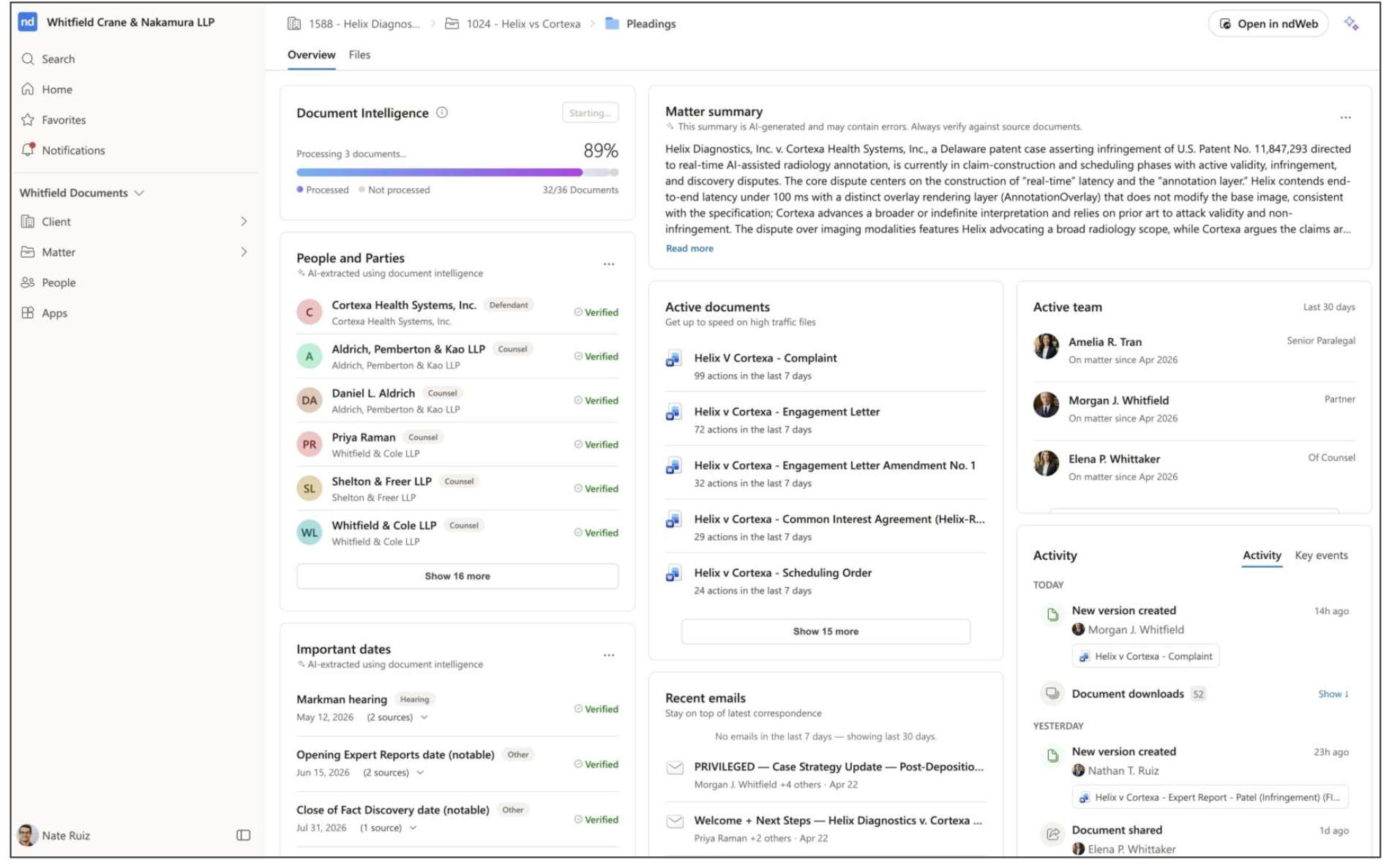
The premise is that bottleneck in legal AI is in what it can see. Everyone’s had an LLM get lazy and go rogue when it can’t immediately find what it’s looking for. Building out these connections greases the wheels for the AI. NetDocuments designed the system with AWS and Elastic to continuously process and connect hundreds of millions of documents under strict governance. It indexes at three levels. There’s the document level — classification, extracted entities, version history with auto-generated summaries of what changed and why. There’s the matter level — auto-assembled overviews, key parties, dates, team visibility, an activity timeline that surfaces both human and AI agent activity. And there’s the global level — natural language search across the whole repository, governed by the same access controls and ethical walls that already exist in the DMS.
A good example of what this looks like in action is its co-authoring feature in Microsoft Word. Attorneys can issue natural-language instructions to update sections of a brief based on, say, a newly added expert report. The graphical connections allow the AI to understand the request and go draw upon the expert report it knows lives within the system.
It’s all about connections. The AI influencers out there talk about maximizing AI by building a “second brain” with connected files. NetDocuments has its indexers doing that automatically every time something gets added. Lawyers have spent years organizing files with folders and idiosyncratic file names. Lawyers are trained to think in terms of v.FINAL_FINAL_clean_jp_v3. But, like the chatbot interface before, NetDocuments is betting that lawyers will embrace this new mode of thinking about document management. Because the AI will definitely prefer it.
 Joe Patrice is a senior editor at Above the Law and co-host of Thinking Like A Lawyer. Feel free to email any tips, questions, or comments. Follow him on Twitter or Bluesky if you’re interested in law, politics, and a healthy dose of college sports news. Joe also serves as a Managing Director at RPN Executive Search.
The post NetDocuments Builds New Concept Of Organization For AI-Powered World appeared first on Above the Law.
When generative AI first crashed into legal, my biggest question wasn’t whether it was useful, but if lawyers would embrace the idea of a chatbot. It worked for the masses, but would lawyers really want to do their work by typing vague questions to an obsequious robot? It turned out, for most lawyers, “typing vague questions to an obsequious robot” was how they’d seen junior associates all along and the chatbot interface took off.
This week, NetDocuments unveiled a new feature that also borrows from the consumer AI world, announcing what it’s calling the first legal context graph — a continuously indexed structure that maps the relationships between every matter, document, and communication in a firm
that connects across hundreds of millions of records. It should go without saying that it does this with full respect for the firm’s existing permissions and ethical walls.
In the consumer AI world, Obsidian took off as a note-taking repository because it allowed users to create graphs to visualize the relationships between notes. NetDocuments offers that concept on steroids, building out the graphical approach for AI’s benefit. To quote from the press release, the result is not a new interface, but a “fundamental shift in what the platform is.” Not that the interface isn’t getting a redesign too, a product of, according to the company, 39 design studies and more than 1,500 participants.
But, and for law firms this is the most important news, users can toggle between the existing and new platform with no technical migration. For those lawyers who hate change.
Taking this graphical approach, NetDocuments endeavors to build a system that truly understands the work it’s storing. By constantly connecting files in the whole repository, a lawyer opening up an unfamiliar matter can see the full context, a summary, key parties, an activity timeline, and the people who have done this work before. The AI working inside NetDocuments (or external tools connected to NetDocs via MCP, like Claude, ChatGPT, or other legal AI applications) can now navigate all these document relationships to deliver the overview and set the stage for the user to begin working within the matter.
The premise is that bottleneck in legal AI is in what it can see. Everyone’s had an LLM get lazy and go rogue when it can’t immediately find what it’s looking for. Building out these connections greases the wheels for the AI. NetDocuments designed the system with AWS and Elastic to continuously process and connect hundreds of millions of documents under strict governance. It indexes at three levels. There’s the document level — classification, extracted entities, version history with auto-generated summaries of what changed and why. There’s the matter level — auto-assembled overviews, key parties, dates, team visibility, an activity timeline that surfaces both human and AI agent activity. And there’s the global level — natural language search across the whole repository, governed by the same access controls and ethical walls that already exist in the DMS.
A good example of what this looks like in action is its co-authoring feature in Microsoft Word. Attorneys can issue natural-language instructions to update sections of a brief based on, say, a newly added expert report. The graphical connections allow the AI to understand the request and go draw upon the expert report it knows lives within the system.
It’s all about connections. The AI influencers out there talk about maximizing AI by building a “second brain” with connected files. NetDocuments has its indexers doing that automatically every time something gets added. Lawyers have spent years organizing files with folders and idiosyncratic file names. Lawyers are trained to think in terms of v.FINAL_FINAL_clean_jp_v3. But, like the chatbot interface before, NetDocuments is betting that lawyers will embrace this new mode of thinking about document management. Because the AI will definitely prefer it.
Joe Patrice is a senior editor at Above the Law and co-host of Thinking Like A Lawyer. Feel free to email any tips, questions, or comments. Follow him on Twitter or Bluesky if you’re interested in law, politics, and a healthy dose of college sports news. Joe also serves as a Managing Director at RPN Executive Search.
The post NetDocuments Builds New Concept Of Organization For AI-Powered World appeared first on Above the Law.