
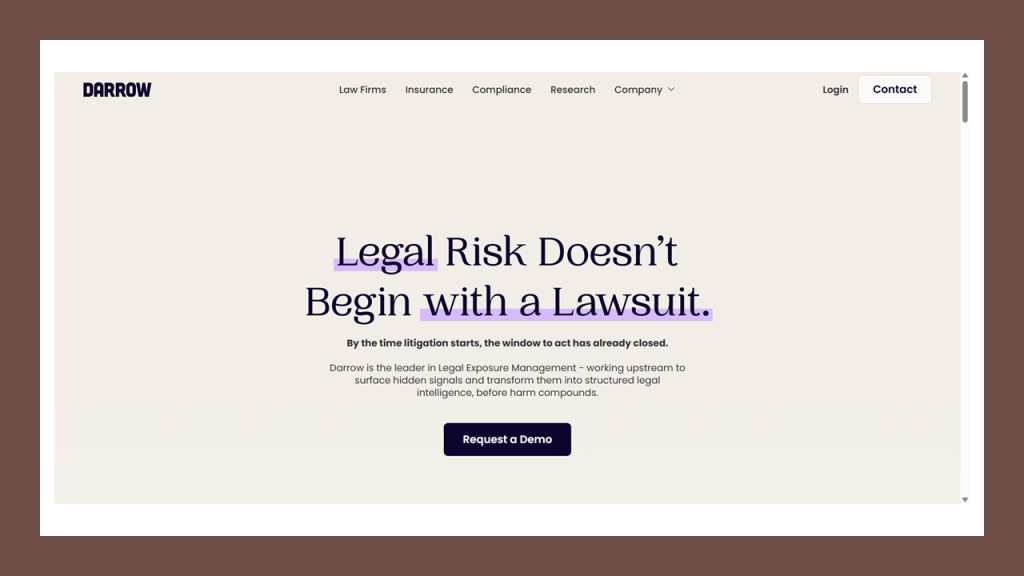
The legal system has a blind spot, often failing to recognize risk until a lawsuit is filed. By that point, it is too late to mitigate and the only course is to react. That is the premise of Darrow, a company that built its early reputation by scanning the web to surface potential class actions. […]
The legal system has a blind spot, often failing to recognize risk until a lawsuit is filed. By that point, it is too late to mitigate and the only course is to react.
That is the premise of Darrow, a company that built its early reputation by scanning the web to surface potential class actions.
This month, Darrow launched a platform designed to enable law firms to run their entire litigation practices the way an investor runs a fund — discovering cases, vetting their merits, predicting how they will resolve, and tracking the whole docket on a single dashboard.
The company announced the launch May 12, calling it an “industry-first” platform for firms to “identify, vet, and manage litigation like a portfolio.”
“Legal exposure doesn’t announce itself,” said Evya Ben Artzi, cofounder and CEO. “It builds quietly across industries, markets, and regulatory environments, often long before anyone acts on it.
“What we’ve built is the infrastructure to see that risk early, and to give the legal ecosystem the intelligence to respond. This platform is the next step in that mission.”
In a briefing last week, Ben Artzi and COO Mathew Keshav Lewis walked me through the product and the broader strategy behind it.
For PI firms, the basic idea is simple. Every contingency case a firm takes is a bet – one that is often placed with incomplete information. Darrow wants to be the intelligence layer that prices the bet before a firm commits its capital and its lawyers’ time.
As a Darrow spokesperson put it to me: “Darrow operates upstream in the legal ecosystem detecting violations, whereas most other tech companies operate downstream after a case has been created, focusing on operational efficiency.”
What The Platform Does
Darrow built its new platform around four capabilities, which Ben Artzi and Lewis demonstrated for me during our briefing last week.
Case discovery. According to Darrow, its AI agents continuously analyze publicly available data across industries to surface litigation exposure, and every opportunity is then “expert-vetted” by former AmLaw 100 attorneys.
In the demo, this took the form of an “explore cases” screen – Ben Artzi described it as “the screen where you’ll get your next case” – populated with matters such as alleged ERISA violations by a named airline and a privacy claim against a named healthcare nonprofit.
Each carried an estimated class size, an estimated time to settlement, projected attorney fees, estimated damages, and the defendant’s annual revenue, which Darrow frames as a proxy for ability to pay.
Case evaluation. Firms can review a “case memo” – a dossier that compiles the evidence and plan documents a firm would need to file – along with comparable-case analytics.
In the demo, one matter was benchmarked against 220 similar cases, with Darrow reporting that 27% reached a court-approved settlement, 26% ended in judgment for the defendant, 16% were voluntarily dismissed, and 19% remained in progress.
These analytics span both federal and state courts. Ben Artzi characterized state courts as historically neglected in conventional litigation analytics despite being, in his words, the largest severity driver in any litigation portfolio.
Portfolio management. A dashboard provides real-time tracking of settlement value, projected net to the firm, case distribution, and litigation stage across active matters, with plaintiff intake and document collection handled in the same place.
Embedded intelligence. This conversational layer, available throughout the platform, lets users query the system on questions such as merits, defendant history, valuation assumptions, or precedent.
Targeting Legal Weaknesses
Underpinning all of this is a taxonomy Darrow has built to map legal risk. Ben Artzi compared it to MITRE ATT&CK, the widely used framework for cataloguing cybersecurity threats.
Darrow’s version enumerates “legal weaknesses” – for example, a privacy entry for inadequate consent mechanisms – each paired with the indicators its agents look for (an “accept all cookies” banner with no granular options, a pre-checked consent box, consent bundled with service access), the related legal vulnerabilities, and the applicable laws and enforcement pathways by jurisdiction.
Ben Artzi said the company tests corporations against 164 such compliance weaknesses across domains, including securities fraud, antitrust, consumer protection, environmental law, privacy, labor and employment, and ERISA.
As an example, Darrow says that in the area of ERISA, its Legal Intelligence team has identified $400 billion in undetected employer exposure – risk not yet litigated or priced into insurance underwriting.
To identify this exposure, they analyzed over 200,000 plan sponsors, 60,000 retirement funds, and more than $6 trillion in plan assets.
In just the past year, Darrow says, it identified over $10.3 billion in exposure impacting over one million plan participants before a single complaint was filed.
More than three quarters of the risk it flagged, totaling $7.7 billion, became active legal cases within the year.
Pricing and Business
Darrow prices its product through a combination of subscription and usage-based fees. The subscription reflects how much coverage a firm wants, while usage scales with the number of cases, exposures and scans a customer runs.
For an insurance customer, for example, that might mean pricing against the number of corporations scanned and the number of legal domains or weaknesses included.
On the business itself, Ben Artzi said Darrow has raised about $60 million in total, has been profitable for three years, and employs roughly 170 people, with most of them in Tel Aviv and others in offices in New York and Miami.
Darrow raised a $35 million Series B led by Georgian in September 2023, with participation from F2 Venture Capital, Entrée Capital, NFX, and Y Combinator, on top of earlier rounds that brought its disclosed total to roughly $60 million.
Ben Artzi, who spent four years as a commander in the Israeli Defense Forces before going to law school, founded the company in 2020, together with CTO Gila Hayat, and Elad Spiegelman. Ben Artzi and Spiegelman met at Hebrew University’s law school and clerked together at the Israeli Supreme Court.
Darrow says litigators using its tools have surfaced $22 billion in litigation-linked risk to date – up from the roughly $10 billion figure the company was citing at the time of its 2023 Series B.
Switching Sides, And Back Again
An interesting part of Darrow’s story is how it arrived at a portfolio product for plaintiffs’ firms, because that is not where it started.
Ben Artzi’s account begins with his time as a Supreme Court clerk, where the volume of wrongdoing that never reaches a courtroom struck him as an intelligence-gathering problem. Lawyers, he argued, lack any systematic way to learn about harm happening in the world before it surfaces on a docket.
He and Hayat – a data scientist who had earlier built systems to codify rules of engagement for military analysts – began with a prototype premised on the idea that it is possible to detect whether a company is breaking the law from external signals alone.
Darrow first took that idea to corporate compliance teams and was rebuffed. Compliance buyers, Ben Artzi said, doubted that anyone could predict where the plaintiffs’ bar would strike and declined to buy.
So the company turned to the other side of the “v.” – to plaintiffs firms and regulators – and found a market. Ben Artzi said that many top U.S. trial firms now use Darrow to source their next case.
Only later, after three or four years of development, did Darrow circle back to the corporate and insurance side, having concluded that the same risk signals it surfaced for plaintiffs could be sold back to compliance teams and insurers as a way to get ahead of exposure.
Today, the company serves law firms, compliance teams, insurers and financial investors.
To use a medical analogy, Darrow offered a form of “preventive medicine” for corporations, identifying small changes to a website, a labor policy, or a pension plan that might head off litigation. In fact, the company now describes itself as a “legal exposure management platform.”
See What Your Adversary Sees
Given Darrow’s multi-sided positioning — selling intelligence to plaintiffs firms, corporate compliance teams, insurers and investors, all at once — I asked Ben Artzi whether corporate or insurance customers were uncomfortable knowing that Darrow also serves the plaintiffs firms that might sue them.
For Darrow’s customers, he responded, a single trusted evaluation, available across the ecosystem, is more valuable than a partisan one. The corporate buyer benefits from seeing “exactly what your adversary is seeing” – the worst-case view of a claim.
He contrasted this with general-purpose AI tools, which he claimed are biased toward whichever side produces more content. Asking a consumer chatbot about a legal issue, he argued, tends to surface defense-firm commentary because plaintiffs firms have smaller marketing budgets.
I also asked Ben Artzi about the concern that serving up the largest, most lucrative cases could lead firms to ignore smaller claims – the individual wage-and-hour client who walks in the door but does not represent a scalable class.
Ben Artzi responded that the real problem is the opposite — that too many matters currently require a day in court and that better data would let parties settle faster.
Further, he said, as companies apply policies more systematically (in part, he suggested, because of AI), genuinely individual violations are declining while systematic, scalable ones are what remain.
He believes AI tools such as Darrow could lead to a world in which frivolous filings fall away because firms have more meaningful, real cases to pursue.
On ethics more broadly, Ben Artzi said he has never heard a customer raise an ethical objection to approaching litigation this way, and that the more common reaction from corporate and compliance officers is a desire to know about exposure as early as possible.
What’s Ahead for Darrow
Darrow’s roadmap includes several notable developments, Ben Artzi said.
Slated to launch in June is an integration with Microsoft that will let users trigger a Darrow scan from Copilot in Teams or from Microsoft Purview.
He also described a forthcoming partnership with a large cybersecurity company, expected to be made public around July, that would sell Darrow’s privacy-exposure capability through that company’s channel.
As for integrations with other legal-AI platforms, he said Darrow’s main integrations today are with general-purpose model providers such as Anthropic and OpenAI, and that the company has not yet found a compelling use case to integrate with platforms such as Harvey or Legora, though he is not opposed to that.
Geographically, Ben Artzi said the legal and compliance business is concentrated in the United States, while the insurance side extends somewhat into Europe and the U.K.
The Bottom Line
I am always skeptical whenever a company waves the claim of having a product that is an “industry first.” In Darrow’s case, however, that claim seems well founded.
For sure, there are other products on the market that overlap with parts of what Darrow does. In its evaluation of litigation risk and exposure, I immediately thought of litigation finance firms. For years, they have performed their own risk and recovery analysis to decide which cases to back.
But Ben Artzi draws a distinction. A litigation funder lacks data on how risk forms in the first place, which is the gap he says Darrow’s “AI lab for legal risk” is built to fill.
In its portfolio management features, Darrow shares some common ground with plaintiff-side AI companies such as EvenUp and Supio. But those companies are more focused on case preparation and do not offer the kind of case sourcing capabilities of Darrow.
What appears genuinely distinctive in Darrow’s approach is less any single feature than the attempt to unify discovery, valuation, and portfolio management into one workflow, and to sell a common intelligence layer to plaintiffs firms, corporates and insurers simultaneously.
As COO Lewis put it: “Contingency litigation has always meant making high-stakes decisions with limited data. Darrow’s new platform brings unique visibility, legal intelligence, and AI driven analytics to make smarter decisions.”