
Ed. note: Please welcome Renee Knake Jefferson back to the pages of Above the Law. Subscribe to her Substack, Legal Ethics Roundup, here.
Welcome to what captivates, haunts, inspires, and surprises me every week in the world of legal ethics.
Happy Monday!
Last week was a flurry of teaching and publishing.
I’m teaching two classes this summer – the mandatory upper-level law school class “Professional Responsibility” and a writing seminar “Leadership, Law & Power.”
I continued to engage with journalists covering discipline in the federal judiciary, this week quoted in the Bloomberg Law article, “Judges’ Misconduct Cases Bring Extra Scrutiny to Strained Courts.” Here’s a brief excerpt:
The recent conduct also raises broader questions on whether the existing systems set up to hold federal judges accountable are effective, as judges face heightened scrutiny in an increasingly politicized environment, said Renee Knake Jefferson, a University of Houston judicial ethics expert. “The danger is not merely reputational harm to those individual judges but an erosion of public confidence in the judiciary as an institution,” Jefferson added. … Jefferson said serious personal misconduct doesn’t always implicate a judge’s behavior on the bench, but that the judiciary has recognized that those unrelated misdeeds can impact the courts. “The question is often not whether the conduct affected a particular case, but whether it undermines confidence in the judge’s ability to uphold the standards of the office,” she said.
Read more here.
My op-ed on solving unmet legal needs and restoring public trust in the justice system was published in the 517 Business Magazine. An excerpt is featured below and you can read it in full here.
Finally, my Michigan Law Review piece “When Lawyers Protest” was published as part of the annual book review issue. Here’s the abstract:
Download the full Review for free here.
What happens when lawyers take to the streets? In May 2025, more than 10,000 lawyers across the United States participated in coordinated ‘Law Day’ demonstrations to defend the rule of law, judicial independence, and constitutional governance. Just four years earlier, however, lawyers played prominent roles in efforts that culminated in the January 6 attack on the U.S. Capitol. These contrasting events expose a fundamental but largely unexplored question in legal ethics: When does lawyer activism strengthen the rule of law, and when does it undermine it?
This Review uses two recent books, Lawyer Nation by Ray Brescia and Canceling Lawyers by W. Bradley Wendel, as a lens through which to examine the ethical obligations of lawyers who engage in protest and other forms of public activism. Although neither book focuses directly on protest, both illuminate the legal profession’s relationship to democracy, accountability, dissent, and the rule of law. Drawing on their historical accounts and contemporary case studies, this Review argues that lawyer protest reveals a significant gap in professional regulation. While lawyers are instructed to uphold the rule of law as officers of the legal system and public citizens, existing professional conduct rules provide little practical guidance about how lawyers should navigate activism undertaken outside the context of client representation.
The Review develops a framework for understanding lawyer protest through case studies ranging from the civil rights movement and climate activism to January 6 and contemporary rule-of-law demonstrations. It argues that legal ethics should neither discourage lawyer participation in democratic protest nor leave such participation entirely unregulated. Instead, professional norms should cultivate protest that advances democratic values, accountability, and constitutional governance while establishing clearer safeguards against conduct that threatens legal institutions and the rule of law itself. In the absence of formal reform, law schools, bar organizations, and nonprofit institutions can play an important role in preparing lawyers to meet these responsibilities.
Highlights from Last Week – Top Ten Headlines
#1 “Lawyers Take to the Streets To Defend the Rule of Law.” From the New York State Bar Association: “Lawyers filled Foley Square in New York City Tuesday to rededicate themselves to defending the rule of law. The theme of the rally was ‘Time to Lawyer Up,’ with speakers encouraging lawyers to step up and take on more pro-bono work defending immigrants and federal workers and protecting voting rights.” Read more here.
#2 “Judge Denies Hannah Dugan’s Bid to Overturn Jury Verdict in ICE Case.” From the Milwaukee Journal Sentinel: “A federal judge has denied former Milwaukee County Circuit Judge Hannah Dugan’s bid to overturn a jury’s verdict that she obstructed ICE agents outside her courtroom in April 2025, putting the case back on track for sentencing.” Read more here.
#3 “What the CLEAR Report Means for Regulation of the Legal Profession.” From Chief Justice Megan K. Cavanah in the Michigan Bar Journal: “‘If you can ‘think’ like a lawyer, does that mean you can ‘act’ like a lawyer?’ That’s the question asked and answered in a report published last year by the Committee on Legal Education and Admissions Reform (the CLEAR report). Endorsed by the Conference of Chief Justices (CCJ) and the Conference of State Court Administrators (COSCA), the report reflects a wide-ranging stakeholder analysis that included feedback from thousands of judges, attorneys, and law students. What did CLEAR find?” Read more here.
#4 “Judge Recuses Herself in Georgia Voter Rolls Case.” From Politico: “An embattled federal judge in Atlanta has agreed to the Justice Department’s request that she step aside from a federal lawsuit seeking access to Georgia’s voter rolls. In an order dated Monday and released Tuesday, U.S. District Judge Eleanor Ross said she was recusing herself from the case due to her attendance at a political event in 2024 for Fulton County District Attorney Fani Willis, who brought a criminal case against President Donald Trump for tampering with the 2020 presidential election.” Read more here.
#5 “Texas Lawyer Beats Suspension Over Opponent No-Contact Rule.” From Bloomberg Law: “Texas disciplinary rules don’t expressly bar an attorney representing himself from contacting an opposing party he knows to be represented by counsel, the state supreme court ruled Friday. Suggesting perhaps an administrative change is coming to prohibit such communications, the justices said the case before them wasn’t the appropriate place to make that change. ‘We do not revise our rules by opinion,’ Justice Debra Lehrmann wrote for a nearly unanimous court. The court’s interpretation of the no-contact rule wipes out a five-year suspension a trial court had imposed against licensed attorney William Ruth, which an appeals court had upheld.” Read more here.
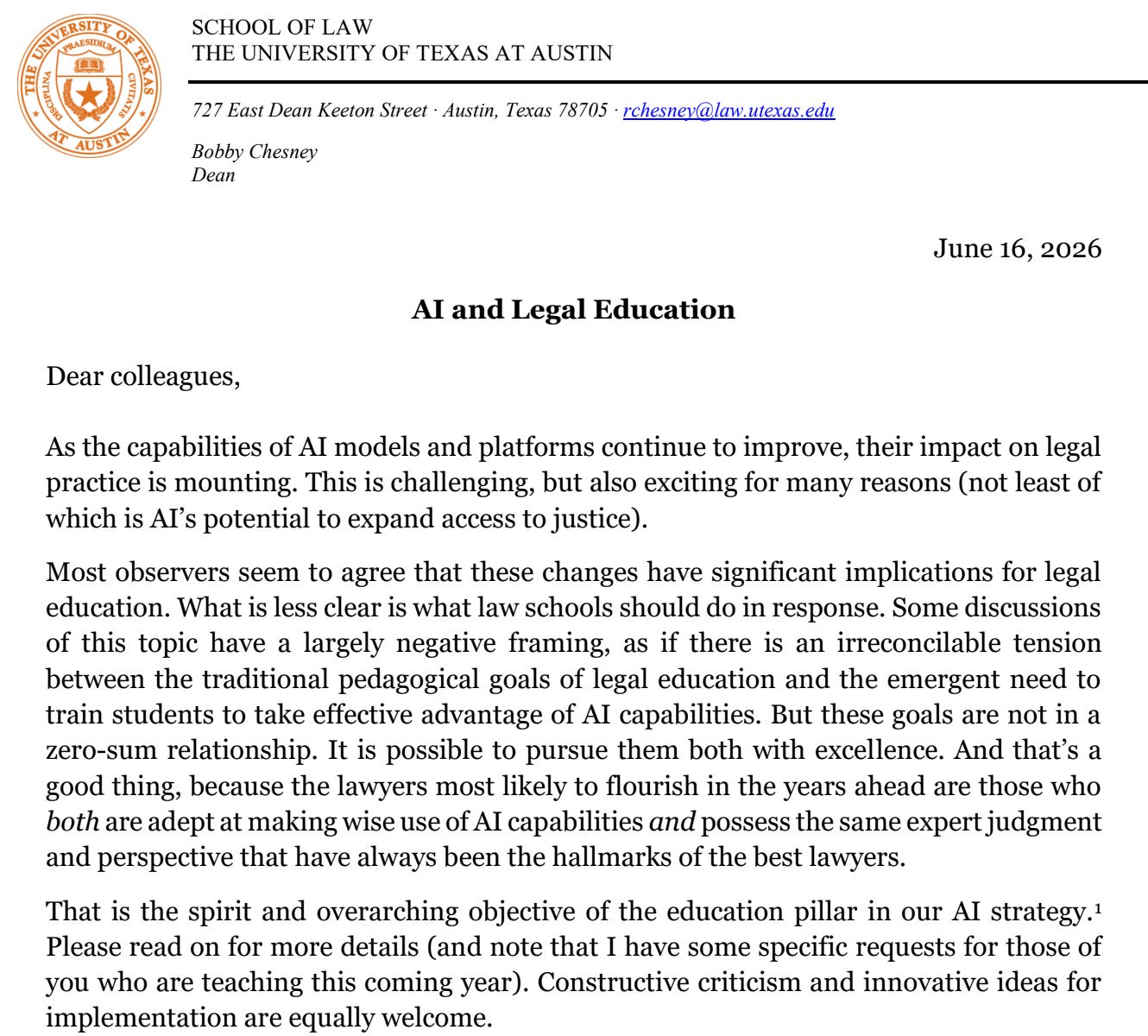
#6 “University of Texas Law Alters AI Policy to Stop Skills Loss.” From Bloomberg Law: “The University of Texas School of Law’s dean is calling for a new approach with generative artificial intelligence policies to counter the risk that the technology will erode the learning of essential skills. Faculty should emphasize Socratic-style questioning in teaching, Dean Robert ‘Bobby’ Chesney said in a Tuesday memo to staff. They should view classroom time as ‘the sole context in which a professor can be certain’ a student is learning without AI.” Read more here.
#7 “SCOTUSblog Founder Goldstein Denied Acquittal Or Retrial.” From Law360: “A Maryland federal judge on Tuesday denied SCOTUSblog founder Tom Goldstein’s bid for an acquittal or new trial, rejecting his claims that issues with jury instructions and excluded evidence warranted a do-over in his tax evasion and mortgage fraud case.” Read more here.
#8 “Supreme Court Won’t Hear Bid By Suspended Judge, 98, to Keep Her Job.” From USA Today: “The U.S. Supreme Court declined on June 15 to hear a bid by the nation’s oldest federal judge, 98-year-old Pauline Newman, to overturn her suspension from duties in 2023 during an investigation into her fitness to serve.” Read more here.
#9 “AI Competence is No Longer Optional, Judges Tell Bar Convention.” From The Florida Bar News: “Florida lawyers have a duty to familiarize themselves with AI, a technology that is already transforming the practice of law and the rules of court procedure, veteran judges warned a symposium June 17 at The Florida Bar Convention in Orlando. ‘We all have a basic requirement to competency and something everybody is going to have to do on this front is at least understand the broad concepts of how these tools work,’ said U.S. Magistrate Judge Nicholas Mizell, who presides in Ft. Myers in the Middle District of Florida.” Read more here.
#10 “Ex-Trump Lawyer Wants Reprimanded Judge’s Jan. 6 Ruling Vacated.” From Bloomberg Law: “Former Trump White House lawyer Stefan Passantino asked a censured federal trial judge in Atlanta to vacate her previous ruling against him in a lawsuit challenging the US House Jan. 6 Committee, citing the judge’s close ties to Democratic Fulton County District Attorney Fani Willis. Judge Eleanor Ross of the US District Court for the Northern District of Georgia has already admitted that she attended a campaign victory party for Willis and recused herself from another political case involving the US Justice Department’s attempt to obtain Georgia voter rolls, Passantino’s Thursday motion said.” Read more here.
Keep in Touch
- News tips? Announcements? Events? A job to post? Reading recommendations? Email legalethics@substack.com – but be sure to subscribe first, otherwise the email won’t be delivered.
- Do you have colleagues who care about legal ethics? Please share the Roundup with them. I’d love to see our community continue to grow!
Renee Knake Jefferson holds the endowed Doherty Chair in Legal Ethics and is a Professor of Law at the University of Houston. Check out more of her writing at the Legal Ethics Roundup. Find her on X (formerly Twitter) at @reneeknake or Bluesky at legalethics.bsky.social.
The post Legal Ethics Roundup: When Lawyers Protest, SCOTX Says Self-Rep Lawyer Can Contact Opposing Party, And More! appeared first on Above the Law.
Ed. note: Please welcome Renee Knake Jefferson back to the pages of Above the Law. Subscribe to her Substack, Legal Ethics Roundup, here.
Welcome to what captivates, haunts, inspires, and surprises me every week in the world of legal ethics.
Happy Monday!
Last week was a flurry of teaching and publishing.
I’m teaching two classes this summer – the mandatory upper-level law school class “Professional Responsibility” and a writing seminar “Leadership, Law & Power.”
I continued to engage with journalists covering discipline in the federal judiciary, this week quoted in the Bloomberg Law article, “Judges’ Misconduct Cases Bring Extra Scrutiny to Strained Courts.” Here’s a brief excerpt:
The recent conduct also raises broader questions on whether the existing systems set up to hold federal judges accountable are effective, as judges face heightened scrutiny in an increasingly politicized environment, said Renee Knake Jefferson, a University of Houston judicial ethics expert. “The danger is not merely reputational harm to those individual judges but an erosion of public confidence in the judiciary as an institution,” Jefferson added. … Jefferson said serious personal misconduct doesn’t always implicate a judge’s behavior on the bench, but that the judiciary has recognized that those unrelated misdeeds can impact the courts. “The question is often not whether the conduct affected a particular case, but whether it undermines confidence in the judge’s ability to uphold the standards of the office,” she said.
Read more here.
My op-ed on solving unmet legal needs and restoring public trust in the justice system was published in the 517 Business Magazine. An excerpt is featured below and you can read it in full here.
Finally, my Michigan Law Review piece “When Lawyers Protest” was published as part of the annual book review issue. Here’s the abstract:
Download the full Review for free here.
What happens when lawyers take to the streets? In May 2025, more than 10,000 lawyers across the United States participated in coordinated ‘Law Day’ demonstrations to defend the rule of law, judicial independence, and constitutional governance. Just four years earlier, however, lawyers played prominent roles in efforts that culminated in the January 6 attack on the U.S. Capitol. These contrasting events expose a fundamental but largely unexplored question in legal ethics: When does lawyer activism strengthen the rule of law, and when does it undermine it?
This Review uses two recent books, Lawyer Nation by Ray Brescia and Canceling Lawyers by W. Bradley Wendel, as a lens through which to examine the ethical obligations of lawyers who engage in protest and other forms of public activism. Although neither book focuses directly on protest, both illuminate the legal profession’s relationship to democracy, accountability, dissent, and the rule of law. Drawing on their historical accounts and contemporary case studies, this Review argues that lawyer protest reveals a significant gap in professional regulation. While lawyers are instructed to uphold the rule of law as officers of the legal system and public citizens, existing professional conduct rules provide little practical guidance about how lawyers should navigate activism undertaken outside the context of client representation.
The Review develops a framework for understanding lawyer protest through case studies ranging from the civil rights movement and climate activism to January 6 and contemporary rule-of-law demonstrations. It argues that legal ethics should neither discourage lawyer participation in democratic protest nor leave such participation entirely unregulated. Instead, professional norms should cultivate protest that advances democratic values, accountability, and constitutional governance while establishing clearer safeguards against conduct that threatens legal institutions and the rule of law itself. In the absence of formal reform, law schools, bar organizations, and nonprofit institutions can play an important role in preparing lawyers to meet these responsibilities.
Highlights from Last Week – Top Ten Headlines
#1 “Lawyers Take to the Streets To Defend the Rule of Law.” From the New York State Bar Association: “Lawyers filled Foley Square in New York City Tuesday to rededicate themselves to defending the rule of law. The theme of the rally was ‘Time to Lawyer Up,’ with speakers encouraging lawyers to step up and take on more pro-bono work defending immigrants and federal workers and protecting voting rights.” Read more here.
#2 “Judge Denies Hannah Dugan’s Bid to Overturn Jury Verdict in ICE Case.” From the Milwaukee Journal Sentinel: “A federal judge has denied former Milwaukee County Circuit Judge Hannah Dugan’s bid to overturn a jury’s verdict that she obstructed ICE agents outside her courtroom in April 2025, putting the case back on track for sentencing.” Read more here.
#3 “What the CLEAR Report Means for Regulation of the Legal Profession.” From Chief Justice Megan K. Cavanah in the Michigan Bar Journal: “‘If you can ‘think’ like a lawyer, does that mean you can ‘act’ like a lawyer?’ That’s the question asked and answered in a report published last year by the Committee on Legal Education and Admissions Reform (the CLEAR report). Endorsed by the Conference of Chief Justices (CCJ) and the Conference of State Court Administrators (COSCA), the report reflects a wide-ranging stakeholder analysis that included feedback from thousands of judges, attorneys, and law students. What did CLEAR find?” Read more here.
#4 “Judge Recuses Herself in Georgia Voter Rolls Case.” From Politico: “An embattled federal judge in Atlanta has agreed to the Justice Department’s request that she step aside from a federal lawsuit seeking access to Georgia’s voter rolls. In an order dated Monday and released Tuesday, U.S. District Judge Eleanor Ross said she was recusing herself from the case due to her attendance at a political event in 2024 for Fulton County District Attorney Fani Willis, who brought a criminal case against President Donald Trump for tampering with the 2020 presidential election.” Read more here.
#5 “Texas Lawyer Beats Suspension Over Opponent No-Contact Rule.” From Bloomberg Law: “Texas disciplinary rules don’t expressly bar an attorney representing himself from contacting an opposing party he knows to be represented by counsel, the state supreme court ruled Friday. Suggesting perhaps an administrative change is coming to prohibit such communications, the justices said the case before them wasn’t the appropriate place to make that change. ‘We do not revise our rules by opinion,’ Justice Debra Lehrmann wrote for a nearly unanimous court. The court’s interpretation of the no-contact rule wipes out a five-year suspension a trial court had imposed against licensed attorney William Ruth, which an appeals court had upheld.” Read more here.
#6 “University of Texas Law Alters AI Policy to Stop Skills Loss.” From Bloomberg Law: “The University of Texas School of Law’s dean is calling for a new approach with generative artificial intelligence policies to counter the risk that the technology will erode the learning of essential skills. Faculty should emphasize Socratic-style questioning in teaching, Dean Robert ‘Bobby’ Chesney said in a Tuesday memo to staff. They should view classroom time as ‘the sole context in which a professor can be certain’ a student is learning without AI.” Read more here.
#7 “SCOTUSblog Founder Goldstein Denied Acquittal Or Retrial.” From Law360: “A Maryland federal judge on Tuesday denied SCOTUSblog founder Tom Goldstein’s bid for an acquittal or new trial, rejecting his claims that issues with jury instructions and excluded evidence warranted a do-over in his tax evasion and mortgage fraud case.” Read more here.
#8 “Supreme Court Won’t Hear Bid By Suspended Judge, 98, to Keep Her Job.” From USA Today: “The U.S. Supreme Court declined on June 15 to hear a bid by the nation’s oldest federal judge, 98-year-old Pauline Newman, to overturn her suspension from duties in 2023 during an investigation into her fitness to serve.” Read more here.
#9 “AI Competence is No Longer Optional, Judges Tell Bar Convention.” From The Florida Bar News: “Florida lawyers have a duty to familiarize themselves with AI, a technology that is already transforming the practice of law and the rules of court procedure, veteran judges warned a symposium June 17 at The Florida Bar Convention in Orlando. ‘We all have a basic requirement to competency and something everybody is going to have to do on this front is at least understand the broad concepts of how these tools work,’ said U.S. Magistrate Judge Nicholas Mizell, who presides in Ft. Myers in the Middle District of Florida.” Read more here.
#10 “Ex-Trump Lawyer Wants Reprimanded Judge’s Jan. 6 Ruling Vacated.” From Bloomberg Law: “Former Trump White House lawyer Stefan Passantino asked a censured federal trial judge in Atlanta to vacate her previous ruling against him in a lawsuit challenging the US House Jan. 6 Committee, citing the judge’s close ties to Democratic Fulton County District Attorney Fani Willis. Judge Eleanor Ross of the US District Court for the Northern District of Georgia has already admitted that she attended a campaign victory party for Willis and recused herself from another political case involving the US Justice Department’s attempt to obtain Georgia voter rolls, Passantino’s Thursday motion said.” Read more here.
Keep in Touch
- News tips? Announcements? Events? A job to post? Reading recommendations? Email legalethics@substack.com – but be sure to subscribe first, otherwise the email won’t be delivered.
- Do you have colleagues who care about legal ethics? Please share the Roundup with them. I’d love to see our community continue to grow!
Renee Knake Jefferson holds the endowed Doherty Chair in Legal Ethics and is a Professor of Law at the University of Houston. Check out more of her writing at the Legal Ethics Roundup. Find her on X (formerly Twitter) at @reneeknake or Bluesky at legalethics.bsky.social.
The post Legal Ethics Roundup: When Lawyers Protest, SCOTX Says Self-Rep Lawyer Can Contact Opposing Party, And More! appeared first on Above the Law.