

This morning, I opened up a link to one of the funniest satirical takes on the Supreme Court ever. Framed as an argument against bringing cameras into the Supreme Court, the article delivers one knee-slapper after another. Halfway through, I’d already spit out my coffee and wiped away tears of laughter. Frankly, The Onion outdid itself. They even slapped the name of former Nebraska Senator Ben Sasse on it.
Then I noticed that the link hadn’t sent me to The Onion. Somehow, I was actually reading the opinion section of the Wall Street Journal. Had Sasse slipped a satire so dry past the WSJ editors that they couldn’t even clock it? Has the former legislator taken to trolling major publications?
Or does he actually believe this tripe?
In a session completely closed off from cameras, Sam Alito decided to break protocol to engage in performative whining that Justice Sotomayor’s dissent made him look bad. And that’s just yesterday! Antonin Scalia was pumping out partisan gasbaggery in written opinions for years. And while the partisan posturing tends to tilt toward the conservatives on the bench — likely because they’re the ones who have to impress a donor class willing to pay under-the-table for their luxury vacations — the system doesn’t limit itself to the Republican justices. Ruth Bader Ginsburg leaned into the Notorious RBG joke with cringey aplomb. Since at least the 1980s, the Court has become a fully partisan project and every word the justices write is etched into national history. Cameras are not the thin line holding back the partisan gasbags on the Court from becoming partisan gasbags.
Cameras change human behavior. They turn conversations into performances. There’s no better proof than a televised congressional hearing. Members of both parties jockey for sound bites. Debate and oversight are long gone because they require thoughtful deliberation, honest questioning and difficult trade-offs. A central goal in 99% of hearings is now for a member of Congress to make a spectacle of himself by arriving loudly, dancing boldly and leaving promptly.
The justices have proven they’re willing to take a dump during oral argument. If that’s the only thing cameras save us from, it’s worth it.
There is some truth to the idea that cameras change behavior. Bravo has made a whole entertainment empire out of this. And they have changed Congress specifically, but the incentive structure is different. Lawmakers preen for cameras because — they think — it helps them keep getting elected. Supreme Court justices don’t have that problem. If anything, the risk of cameras in the Supreme Court is that it leads justices to become more withdrawn, afraid of saying something that might accidentally reveal the cynical hackery at work. Would Alito have thrown yesterday’s revealing tantrum in front of a camera? Probably, because he’s petty like that. But he might not have.
Members use their time to talk at witnesses with fire and brimstone. Maybe they throw in an occasional question: “Just how much do you hate puppies?” If they can rankle the witnesses, great. If they can get scolded by the other side, even better. The hearings are different and the topics change, but the basic message is always the same: “I’m the only one fighting the good fight here.”
A lawmaker nearly beat Senator Sumner to death with a cane. I think legislative combativeness predates C-SPAN.
Once a member has a clip, he packages it for social media and ships it to his followers. He also sends it to his online fundraising teams to raise a quick buck and acquire email addresses. Last, but not least, he uses it to get on TV where he can preach to the choir and film more clips. Wash, rinse, repeat.
Sounds like a good argument for campaign finance reform. Obviously, justices don’t need email mailing lists — leonard.leo@geocities.com works just fine for a quick buck — but it’s the same game.
The Supreme Court isn’t a political arena. In America’s constitutional system, judges don’t make laws; they apply them. Good justices come to the bench with humility, cloak themselves in black robes, and set aside their personal preferences. The Supreme Court wasn’t designed to reflect the will of a majority or embrace the popular opinions of the day. That’s supposed to be the legislature’s job.
HANG IT IN THE LOUVRE! Or at least in Harlan Crow’s Nazi memorabilia collection. Every sentence is a comic masterpiece.
The Supreme Court isn’t a political arena.
No one buys this anymore. When Justice Scalia died, Ben Sasse used the opportunity to go on camera and post a YouTube of disingenuous argle-bargle about the only acceptable nominee being a nonpartisan judge who would agree that Barack Obama was an unconstitutional pox on America. Then he joined the rest of the Republicans in the Senate in holding the Supreme Court seat vacant in a flagrant act of political partisanship, without even holding hearings to give the appearance of fulfilling their constitutional duty. And when asked about his actions, he just offered trademarked cowardly nonsense. “Well, I mean, I think we could have infinite theoretical and historical debates about the Biden rule and the Schumer rule and the so-called first term rule and the lame duck of a presidency rule,” he told NPR, listing a series of bogus whataboutism “rules” without even dignifying the public with a half-hearted attempt to sort out a coherent reason why any specific one would apply.
It probably goes without saying, but whatever deeply principled belief Sasse had in those rules conveniently evaporated in time for the self-described “founding member of the ACB for SCOTUS club” to elevate Amy Coney Barrett. Later in this article, Sasse writes, “People talk about the justices as if they wear red and blue robes,” which is pure comedic gold coming from him.
In America’s constitutional system, judges don’t make laws; they apply them.
Ha. The Supreme Court has spent the last couple years making up all sorts of new laws without a single congressional statute to back it up. This is a vibes-based Court not only willing to make its own laws, but willing to replace decades worth of actual laws with their own whims.
Good justices come to the bench with humility, cloak themselves in black robes, and set aside their personal preferences.
What in the “No More Souters” is this?
The Supreme Court wasn’t designed to reflect the will of a majority or embrace the popular opinions of the day. That’s supposed to be the legislature’s job.
The Framers didn’t envision the Supreme Court having anywhere near this kind of power either. But his point is sort of true. The judicial system isn’t intended to respond instantly to popular opinion. But the reason judges are picked by the president and confirmed by the legislature is to create a lagging indicator of the national consensus. It would shock the conscience of the Framers to learn that Supreme Court justices are now picked as young as possible to exert deadhand, unaccountable policymaking authority based on the vagaries of actuarial charts.
Then again, the Framers would be shocked that there have been Jews, Catholics, women, and Black people on the Supreme Court, so this would probably be the least of their confusion.
Pundits love to exaggerate 6-3 decisions and comment breathlessly on the political consequences of splits, but most cases are decided 9-0.
Yes, it’s just the consequential ones that end up split. Weird. Fun fact: if the case is a snoozefest about ERISA, cameras in the courtroom are not going to change that. People just won’t tune in.
Except the ERISA sickos.
All of this is completely unnecessary because the court doesn’t have a transparency problem. Proceedings are exhaustively covered by the media. Audio is broadcast around the world. Journalists literally sprint to the cameras when opinions are released. None of that is going away.
If the status quo is already transparent, then why aren’t all of these supposed showboating drawbacks already here? And maybe some of you think they are, but the point is cameras aren’t uniquely adding to the problem.
Putting cameras in the court would dramatically change the nature of the proceedings, create perverse incentives and further erode the public’s trust in the institution. Nobody grasps this better than senators who want to serve in the world’s greatest deliberative body but feel stuck in a never-ending circus. Many of my former colleagues understand this but feel bullied by cheap sound bites about transparency.
Again… Ben Sasse made an unsolicited YouTube to snark about Barack Obama filling Scalia’s vacancy. No one understands turning the Senate into a never-ending circus more than Sasse.
Bringing us full circle… does he really believe this? The arguments he puts forward are all ripe for parody. Compelling arguments against cameras exist — the aforementioned increased incentive to “hide the ball” in proceedings, the pressure to limit nominees to photogenic options, the fact that it adds minimal transparency because oral argument and decision days aren’t really where the chicanery happens anyway) — but Sasse doesn’t go into those.
The idea that cameras might accidentally make the Supreme Court partisan reads like pitch-perfect satire. It’s actually scary that he’s almost certainly trying to be serious.
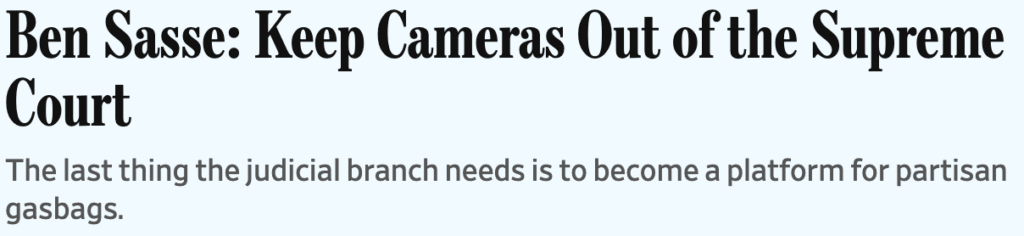
Ben Sasse: Keep Cameras Out of the Supreme Court [Wall Street Journal]
Earlier: Sam Alito Takes Unusual Step Of Whining From The Bench After Getting Called Out For Lazy Hackery
Supreme Court Term Limits Are The Least Dangerous, Most Necessary Reform On The Menu
 Joe Patrice is a senior editor at Above the Law and co-host of Thinking Like A Lawyer. Feel free to email any tips, questions, or comments. Follow him on Twitter or Bluesky if you’re interested in law, politics, and a healthy dose of college sports news.
The post Ben Sasse Pens Hilarious Supreme Court Satire, But I’m Afraid He’s Totally Serious appeared first on Above the Law.
This morning, I opened up a link to one of the funniest satirical takes on the Supreme Court ever. Framed as an argument against bringing cameras into the Supreme Court, the article delivers one knee-slapper after another. Halfway through, I’d already spit out my coffee and wiped away tears of laughter. Frankly, The Onion outdid itself. They even slapped the name of former Nebraska Senator Ben Sasse on it.
Then I noticed that the link hadn’t sent me to The Onion. Somehow, I was actually reading the opinion section of the Wall Street Journal. Had Sasse slipped a satire so dry past the WSJ editors that they couldn’t even clock it? Has the former legislator taken to trolling major publications?
Or does he actually believe this tripe?
In a session completely closed off from cameras, Sam Alito decided to break protocol to engage in performative whining that Justice Sotomayor’s dissent made him look bad. And that’s just yesterday! Antonin Scalia was pumping out partisan gasbaggery in written opinions for years. And while the partisan posturing tends to tilt toward the conservatives on the bench — likely because they’re the ones who have to impress a donor class willing to pay under-the-table for their luxury vacations — the system doesn’t limit itself to the Republican justices. Ruth Bader Ginsburg leaned into the Notorious RBG joke with cringey aplomb. Since at least the 1980s, the Court has become a fully partisan project and every word the justices write is etched into national history. Cameras are not the thin line holding back the partisan gasbags on the Court from becoming partisan gasbags.
Cameras change human behavior. They turn conversations into performances. There’s no better proof than a televised congressional hearing. Members of both parties jockey for sound bites. Debate and oversight are long gone because they require thoughtful deliberation, honest questioning and difficult trade-offs. A central goal in 99% of hearings is now for a member of Congress to make a spectacle of himself by arriving loudly, dancing boldly and leaving promptly.
The justices have proven they’re willing to take a dump during oral argument. If that’s the only thing cameras save us from, it’s worth it.
There is some truth to the idea that cameras change behavior. Bravo has made a whole entertainment empire out of this. And they have changed Congress specifically, but the incentive structure is different. Lawmakers preen for cameras because — they think — it helps them keep getting elected. Supreme Court justices don’t have that problem. If anything, the risk of cameras in the Supreme Court is that it leads justices to become more withdrawn, afraid of saying something that might accidentally reveal the cynical hackery at work. Would Alito have thrown yesterday’s revealing tantrum in front of a camera? Probably, because he’s petty like that. But he might not have.
Members use their time to talk at witnesses with fire and brimstone. Maybe they throw in an occasional question: “Just how much do you hate puppies?” If they can rankle the witnesses, great. If they can get scolded by the other side, even better. The hearings are different and the topics change, but the basic message is always the same: “I’m the only one fighting the good fight here.”
A lawmaker nearly beat Senator Sumner to death with a cane. I think legislative combativeness predates C-SPAN.
Once a member has a clip, he packages it for social media and ships it to his followers. He also sends it to his online fundraising teams to raise a quick buck and acquire email addresses. Last, but not least, he uses it to get on TV where he can preach to the choir and film more clips. Wash, rinse, repeat.
Sounds like a good argument for campaign finance reform. Obviously, justices don’t need email mailing lists — leonard.leo@geocities.com works just fine for a quick buck — but it’s the same game.
The Supreme Court isn’t a political arena. In America’s constitutional system, judges don’t make laws; they apply them. Good justices come to the bench with humility, cloak themselves in black robes, and set aside their personal preferences. The Supreme Court wasn’t designed to reflect the will of a majority or embrace the popular opinions of the day. That’s supposed to be the legislature’s job.
HANG IT IN THE LOUVRE! Or at least in Harlan Crow’s Nazi memorabilia collection. Every sentence is a comic masterpiece.
The Supreme Court isn’t a political arena.
No one buys this anymore. When Justice Scalia died, Ben Sasse used the opportunity to go on camera and post a YouTube of disingenuous argle-bargle about the only acceptable nominee being a nonpartisan judge who would agree that Barack Obama was an unconstitutional pox on America. Then he joined the rest of the Republicans in the Senate in holding the Supreme Court seat vacant in a flagrant act of political partisanship, without even holding hearings to give the appearance of fulfilling their constitutional duty. And when asked about his actions, he just offered trademarked cowardly nonsense. “Well, I mean, I think we could have infinite theoretical and historical debates about the Biden rule and the Schumer rule and the so-called first term rule and the lame duck of a presidency rule,” he told NPR, listing a series of bogus whataboutism “rules” without even dignifying the public with a half-hearted attempt to sort out a coherent reason why any specific one would apply.
It probably goes without saying, but whatever deeply principled belief Sasse had in those rules conveniently evaporated in time for the self-described “founding member of the ACB for SCOTUS club” to elevate Amy Coney Barrett. Later in this article, Sasse writes, “People talk about the justices as if they wear red and blue robes,” which is pure comedic gold coming from him.
In America’s constitutional system, judges don’t make laws; they apply them.
Ha. The Supreme Court has spent the last couple years making up all sorts of new laws without a single congressional statute to back it up. This is a vibes-based Court not only willing to make its own laws, but willing to replace decades worth of actual laws with their own whims.
Good justices come to the bench with humility, cloak themselves in black robes, and set aside their personal preferences.
What in the “No More Souters” is this?
The Supreme Court wasn’t designed to reflect the will of a majority or embrace the popular opinions of the day. That’s supposed to be the legislature’s job.
The Framers didn’t envision the Supreme Court having anywhere near this kind of power either. But his point is sort of true. The judicial system isn’t intended to respond instantly to popular opinion. But the reason judges are picked by the president and confirmed by the legislature is to create a lagging indicator of the national consensus. It would shock the conscience of the Framers to learn that Supreme Court justices are now picked as young as possible to exert deadhand, unaccountable policymaking authority based on the vagaries of actuarial charts.
Then again, the Framers would be shocked that there have been Jews, Catholics, women, and Black people on the Supreme Court, so this would probably be the least of their confusion.
Pundits love to exaggerate 6-3 decisions and comment breathlessly on the political consequences of splits, but most cases are decided 9-0.
Yes, it’s just the consequential ones that end up split. Weird. Fun fact: if the case is a snoozefest about ERISA, cameras in the courtroom are not going to change that. People just won’t tune in.
Except the ERISA sickos.
All of this is completely unnecessary because the court doesn’t have a transparency problem. Proceedings are exhaustively covered by the media. Audio is broadcast around the world. Journalists literally sprint to the cameras when opinions are released. None of that is going away.
If the status quo is already transparent, then why aren’t all of these supposed showboating drawbacks already here? And maybe some of you think they are, but the point is cameras aren’t uniquely adding to the problem.
Putting cameras in the court would dramatically change the nature of the proceedings, create perverse incentives and further erode the public’s trust in the institution. Nobody grasps this better than senators who want to serve in the world’s greatest deliberative body but feel stuck in a never-ending circus. Many of my former colleagues understand this but feel bullied by cheap sound bites about transparency.
Again… Ben Sasse made an unsolicited YouTube to snark about Barack Obama filling Scalia’s vacancy. No one understands turning the Senate into a never-ending circus more than Sasse.
Bringing us full circle… does he really believe this? The arguments he puts forward are all ripe for parody. Compelling arguments against cameras exist — the aforementioned increased incentive to “hide the ball” in proceedings, the pressure to limit nominees to photogenic options, the fact that it adds minimal transparency because oral argument and decision days aren’t really where the chicanery happens anyway) — but Sasse doesn’t go into those.
The idea that cameras might accidentally make the Supreme Court partisan reads like pitch-perfect satire. It’s actually scary that he’s almost certainly trying to be serious.
Ben Sasse: Keep Cameras Out of the Supreme Court [Wall Street Journal]
Earlier: Sam Alito Takes Unusual Step Of Whining From The Bench After Getting Called Out For Lazy Hackery
Supreme Court Term Limits Are The Least Dangerous, Most Necessary Reform On The Menu
Joe Patrice is a senior editor at Above the Law and co-host of Thinking Like A Lawyer. Feel free to email any tips, questions, or comments. Follow him on Twitter or Bluesky if you’re interested in law, politics, and a healthy dose of college sports news.
The post Ben Sasse Pens Hilarious Supreme Court Satire, But I’m Afraid He’s Totally Serious appeared first on Above the Law.