
Karen Skinner | The mental skills a creative practice builds are the same ones that make you a better leader.
The post Why Creativity Is a Leadership Skill, Not a Hobby appeared first on Articles, Tips and Tech for Law Firms and Lawyers.
Creative practices aren’t just an escape. In the latest edition of her creativity and productivity series, Karen Dunn Skinner explores the connection between law firm leadership and creativity.

Highlights
- Creative practice builds cognitive flexibility, which is essential for navigating business and client matters.
- Leaders who foster creative thinking are better equipped to adapt to changes and innovate during economic uncertainty.
- The World Economic Forum’s 2025 Future of Jobs Report flagged creativity as one of the fastest-growing skills in demand.
When lawyers describe their creative pursuits, whether it’s painting, gardening, playing an instrument, or cooking, they almost always use the language of escape. “It’s my break from work.” “It’s time away from the office.” “It’s how I turn my brain off.”
That framing isn’t wrong. Creative activity does offer a break from the demanding, effortful thinking that legal work requires, as I’ve written about earlier in this series. But filing creativity under “escape” or “self-care” misses something important: the mental skills a creative practice builds are the same ones that make you a better leader.
Leadership Training and Your Creative Practice
Creativity isn’t time away from leadership. In many ways, it’s training for it.
Think about what a genuinely creative activity asks of you. You have to tolerate not knowing exactly how something will turn out. You have to generate more than one option before settling on an approach or changing your approach midstream if it’s not working. You have to notice a connection between two things that don’t obviously belong together: a color and a mood, an ingredient and a technique, a chord progression and a feeling. None of that is decorative. It’s in the same cognitive territory as good business judgment: comfort with ambiguity, the ability to generate options rather than defaulting to the first idea, and pattern recognition across situations that don’t look alike on the surface.
Cognitive Flexibility and Leadership
Researchers refer to this cluster of abilities as cognitive flexibility, and it has become a closely studied trait in leadership research over the past several years. A 2025 study published in the Journal of Occupational and Organizational Psychology, which tested across employee samples in both retail and R&D settings, found that leaders who foster cognitive flexibility in their teams, including the capacity to shift perspective and generate more than one approach to a problem, see measurably higher creative output than leaders who don’t.
The World Economic Forum’s 2025 Future of Jobs Report ranked creative thinking among the top five core skills employers look for. And the report flagged it as one of the fastest-growing skills in demand, particularly as organizations navigate economic uncertainty and the need to keep innovating despite tighter constraints.
This is not a coincidence, and it’s not about creativity in the purely artistic sense. It’s that the specific cognitive skills creativity builds—tolerance for ambiguity, comfort generating options, and the ability to notice unlikely patterns—are exactly the skills leaders need most when the path forward isn’t obvious.
The path forward on a client matter is rarely obvious. Deciding which arguments to pursue or how to navigate a complex negotiation requires creative thinking.
Applying Creative Thinking to Law Firm Strategy
Right now, the path forward for our law firm businesses and our profession as a whole also isn’t obvious. Figuring out how to adapt to the rapidly changing technology landscape, price a new service, decide whether to bring on a lateral hire, or how to restructure a team that has outgrown its current shape all require the same kind of thinking that creative practice trains.
Most of us know this instinctively, although we may never have put a name to it. Think about the best strategic idea you’ve had recently, one that solved a problem cleanly instead of just patching it. There’s a good chance it didn’t arrive while you were staring directly at the problem. It arrived sideways, while you were doing something else entirely: painting, cooking, driving, or walking the dog. That’s not an accident of timing. It’s your brain doing exactly what creative activity trains it to do: making connections that your analytical mind, locked onto the problem, couldn’t make on its own.
Reframing Your Creative Time
If you’ve been treating your creative practice as something separate from your role as a firm leader (maybe even something you feel slightly guilty about protecting when there’s client work to do), I’d invite you to reconsider that framing. You’re not stepping away from leadership when you pick up a paintbrush or a guitar. You’re training the exact capacities—tolerance for ambiguity, resilience, openness to more than one answer, the ability to see a pattern before it’s obvious—that you need to make the hard decisions for your business.
That doesn’t mean every creative act needs to be justified by its usefulness to your law practice. It doesn’t. The rest and recovery benefits are reason enough on their own.
So next time you are tempted to drop your creative practice the moment your calendar fills up, remember it isn’t separate from your leadership development. It’s part of it.
Law Firm Leadership and Creativity FAQs
Catch up on Karen Skinner’s Lawyer Creativity Series
“The Law Firm Productivity Myth That’s Burning Lawyers Out”
“Why Your Brain Needs Creative Rest (and What That Actually Looks Like)”
“Did You Know Being a Terrible Guitar Player Could Make You a Better Lawyer?”
“Restore Your Energy and Productivity — Five Minutes at a Time”
More Healthy Lawyer Productivity Tips
- Micro-Recovery: 5 Small, Realistic Ways to Reduce Stress During a Busy Workday
- How Doodling Makes You a Better Listener (and 3 More Benefits)
- Delegation Isn’t Just a Work Hack, It’s a Life Hack: 5 Personal Tasks to Delegate Now
- Got a Process for Your Processes? Create Law Firm SOPs in 5 Easy Steps
- Why Lawyers Need Boredom
- Indoor Fitness Tips for Attorneys With Busy Schedules
- Why Are You at the Office Until 10 p.m.?
- Top-Rated Mindfulness and Meditation Apps
- How to Be Productive When You’re Depressed
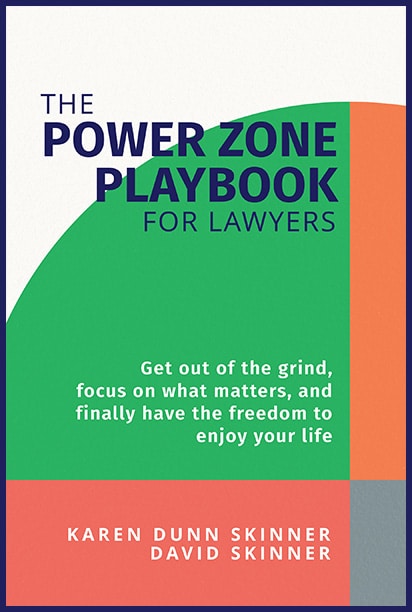
Get the Power Zone Playbook for Lawyers
By Karen Dunn Skinner and David Skinner
Get out of the grind and into your power zone! Learn to align the work you do with the work you love, finding the sweet spot where your expertise, passion, and client needs intersect. It’s here, in your Power Zone, that you will discover the secret to a thriving practice.
Everything you need is in your Playbook.
Images © iStockPhoto.com