
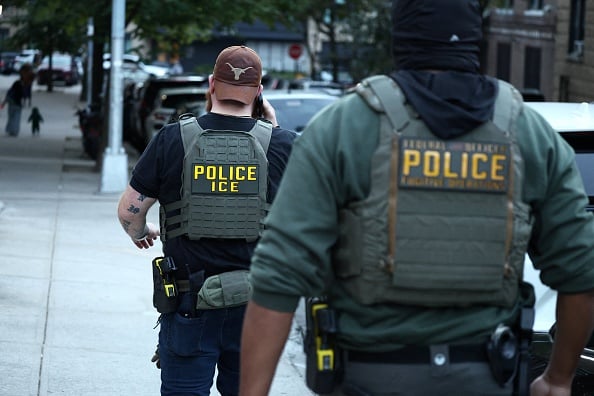
We all know ICE officers can’t be trusted. Neither can the agency that heads up most of Trump’s anti-migrant activities. Every murder by immigration officers is immediately greeted with self-justifying lies about “threats” to officers. Every assault gets the same treatment. Every recorded instance of abuse is immediately rebutted by bullshit claims about violent resistance or, at the very least, that any actions the officers took were justified because the person deserved to be arrested.
The DOJ has been dangling by several threads for months now. Federal court judges have made the point (repeatedly!) that it can no longer trust the government to be acting in good faith. The “presumption of regularity” — the ideal that states that both sides of a court case are doing their honest best under the law — is no longer a privilege the DOJ can expect to avail itself of.
It gets so much worse when the topic shifts to Trump’s mass deportation programs. The government has renditioned people to torture prisons in foreign countries, actively dodged court orders with late-night flights and other fuckery, eliminated due process for migrants by both misquoting the law and shuffling detainees from prison camp to prison camp to ensure they’ll never have standing to sue due to filing a lawsuit in the “wrong” jurisdiction.
ICE has done more than most to earn the distrust of federal courts. It’s something that begins with the masks and the refusal to properly identify themselves and ends with the lies officers put in their reports and, on rare occasions, repeat in court when asked to testify.
A federal judge in Oregon (Mustafa T. Kasubhai) is sick of this shit. Whether or not his personal sickness will infect the rest of the court system remains to be seen, but at least he’s doing everything he can to talk other courts into treating ICE officers as inherently unreliable witnesses. (h/t Kyle Cheney)
This order [PDF], handed down in a case involving a violation of a previous court order forbidding warrantless arrests by ICE officers in Oregon, gets right to the point in the opening paragraphs, saying what needs to be said about ICE and its officers:
An ICE officer fabricated facts in official records to justify an arrest. This Court knows this because at an evidentiary hearing on Plaintiffs’ Motion to Enforce Preliminary Injunction, he testified under oath that what he wrote in the official records of the arrest were incorrect. On the witness stand he minimized the error as mere oversight. This Court found he lied after evaluating his live testimony and the documentary evidence.
Evaluating live testimony is a time-tested method for truth finding. Written declarations are convenient, but insufficient on their own when witnesses are willing to lie. This enforcement action is a powerful reminder of two principles.
First, uncovering truth is not a passive activity. Developing a robust evidentiary record
worthy of telling the story of what really happened can never fully materialize from a stack ofsigned written statements. Live testimony is necessary. Examination and cross-examination are necessary. The trial courts are the uniquely specialized forum in which building a full evidentiary record is possible.Second, this case underscores what happens if people were not called to testify under oath in a courtroom, if as a society we do not demand that government agents explain their actions, and if the public fails to shine a spotlight on what is happening under cover—people with authority know they will not be held to account.
What follows are multiple examples of the lies told by ICE officers to justify warrantless arrests they had already been forbidden to perform. How did the court determine this? By putting officers on the stand and forcing them to talk their way out of their web of lies — something that rarely happened.
CIP #1:
Based on the substance of H-D-G-H-’s testimony and his demeanor, the Court finds that
H-D-G-H-’s account is credible and that Officer J.G.’s testimony is false.[…]
The I-213 for H-D-G-H-’s arrest describes a series of events that Officer J.G. now admits
never occurred.
Featured in this testimony as well: ICE stating it performed only 13 warrantless arrests, despite performing 504 “non-custodial” arrests, which were exactly the sort of arrests that tended to be warrantless and led to the injunction blocking these arrests, which ICE apparently chose to ignore. Also: the officer testifying that he and his fellow officers kept a bunch I-200 forms in their vehicles, with “pre-printed probable cause determinations[s]” on them, apparently in order to expedite warrantless arrests.
In another case, ICE officers claimed that a warrant for which a migrant had already been arrested, detained, and released justified their own warrantless arrest. That claim again results in the ignition of righteous anger from the judge:
The 2023 warrant states that an ICE officer served the warrant on J-C-C-V- in McAllen,Texas, on April 25, 2023. ICE detained J-C-C-V- for eight days in 2023. Now, Defendants contend that the same warrant would have permitted officers to rearrest J-C-C-V- in 2026. Under 8 U.S.C. § 1226(b), the Attorney General can rearrest individuals based on previously executed warrants.
However, a key detail Defendants ignore is the Attorney General must first “revoke a bond or parole” before rearresting. 8 U.S.C. § 1226(b). Defendants presented no evidence of revocation. Instead, Defendants argue through their counsel, that the I-213 form for J-C-C-V- “indicates there was an intention to revoke the bond or parole.” Tr. 250. Intention does not constitute revocation, and the Court admonishes counsel that they are expected to make good faith arguments as officers of the court. Real people’s lives and liberties are at stake and they should remember that. Evidentiary hearings are not first-year law school examinations where one can score points with a scattershot strategy.
From there, the court moves on to point out how absolutely necessary it is to put officers on the stand, especially when the government has repeatedly shown it is not to be trusted.
The more insidious problems with Defendants’ documentation are the errors not apparenton the face of the documents. For example, and as discussed above in greater detail, Officer J.G. testified during the evidentiary hearing that the I-213 for H-D-G-H- failed to accurately describe the circumstances of H-D-G-H-’s arrest. Tr. 163. Officer J.G. lied in the I-213 by copying the language that he wrote in the report for driver M-T-M-, the initial target of Officer J.G.’s investigation. Tr. 163; Pls.’ Ex. 112. Anyone reading the I-213 for H-D-G-H- would believe that
Officer J.G. had identified H-D-G-H- before conducting the investigatory stop, yet Officer J.G. admitted that he had no idea who H-D-G-H- was or that H-D-G-H- was even in the car until after
the stop occurred. Tr. 163. Had this Court not conducted an evidentiary hearing, and had OfficerJ.G. never testified, Officer J.G.’s falsification of H-D-G-H-’s I-213 form would have been left unchallenged and never corrected.
That’s the damage done by just a single warrantless arrest that federal officers lied about in both the initial report and while testifying in court. There’s more in the order, but this is how it’s all summed up:
The presumption of regularity directs the courts to assume, unless clear evidence indicates differently, that government officials have properly discharged their duties, acted in good faith and followed required procedures. This presumption no longer holds for Defendants. The evidence in this case proves as much.
That points directly back to the opening paragraphs of the decision. This court is stating plainly that the government cannot be taken at its word. Since that’s the new normal, courts need to respond by putting as many ICE officers on the stand as possible during cases like these. What was seen here will be seen elsewhere: that when officers are ordered to explain the deficiencies in their warrants, narratives, or whatever else, they’re going to expose themselves for the liars they are. And if they aren’t actually lying, that much will be made apparent through direct testimony and cross-examination. Allowing the government to get away with lying by refusing to challenge the boilerplate just makes things worse for Americans and better for the bitter, bigoted facists who think they should just be able to get away with all of this.
Judge: ICE Officers Can’t Be Trusted And The Only Way To Fix This Is To Put Them On The Stand
More Law-Related Stories From Techdirt:
ICE Is Now Arresting People Who’ve Been Released From ICE Detention By Court Orders
The Tech Bros Who Bet On Fascism Lost. Don’t Let The Internet Pay For It.
DOJ Admits Its ‘Illegal Voter’ Lists Can’t Be Trusted, Leading To Three Court Losses In 24 Hours
The post Judge: ICE Officers Can’t Be Trusted And The Only Way To Fix This Is To Put Them On The Stand appeared first on Above the Law.

We all know ICE officers can’t be trusted. Neither can the agency that heads up most of Trump’s anti-migrant activities. Every murder by immigration officers is immediately greeted with self-justifying lies about “threats” to officers. Every assault gets the same treatment. Every recorded instance of abuse is immediately rebutted by bullshit claims about violent resistance or, at the very least, that any actions the officers took were justified because the person deserved to be arrested.
The DOJ has been dangling by several threads for months now. Federal court judges have made the point (repeatedly!) that it can no longer trust the government to be acting in good faith. The “presumption of regularity” — the ideal that states that both sides of a court case are doing their honest best under the law — is no longer a privilege the DOJ can expect to avail itself of.
It gets so much worse when the topic shifts to Trump’s mass deportation programs. The government has renditioned people to torture prisons in foreign countries, actively dodged court orders with late-night flights and other fuckery, eliminated due process for migrants by both misquoting the law and shuffling detainees from prison camp to prison camp to ensure they’ll never have standing to sue due to filing a lawsuit in the “wrong” jurisdiction.
ICE has done more than most to earn the distrust of federal courts. It’s something that begins with the masks and the refusal to properly identify themselves and ends with the lies officers put in their reports and, on rare occasions, repeat in court when asked to testify.
A federal judge in Oregon (Mustafa T. Kasubhai) is sick of this shit. Whether or not his personal sickness will infect the rest of the court system remains to be seen, but at least he’s doing everything he can to talk other courts into treating ICE officers as inherently unreliable witnesses. (h/t Kyle Cheney)
This order [PDF], handed down in a case involving a violation of a previous court order forbidding warrantless arrests by ICE officers in Oregon, gets right to the point in the opening paragraphs, saying what needs to be said about ICE and its officers:
An ICE officer fabricated facts in official records to justify an arrest. This Court knows this because at an evidentiary hearing on Plaintiffs’ Motion to Enforce Preliminary Injunction, he testified under oath that what he wrote in the official records of the arrest were incorrect. On the witness stand he minimized the error as mere oversight. This Court found he lied after evaluating his live testimony and the documentary evidence.
Evaluating live testimony is a time-tested method for truth finding. Written declarations are convenient, but insufficient on their own when witnesses are willing to lie. This enforcement action is a powerful reminder of two principles.
First, uncovering truth is not a passive activity. Developing a robust evidentiary record
worthy of telling the story of what really happened can never fully materialize from a stack ofsigned written statements. Live testimony is necessary. Examination and cross-examination are necessary. The trial courts are the uniquely specialized forum in which building a full evidentiary record is possible.Second, this case underscores what happens if people were not called to testify under oath in a courtroom, if as a society we do not demand that government agents explain their actions, and if the public fails to shine a spotlight on what is happening under cover—people with authority know they will not be held to account.
What follows are multiple examples of the lies told by ICE officers to justify warrantless arrests they had already been forbidden to perform. How did the court determine this? By putting officers on the stand and forcing them to talk their way out of their web of lies — something that rarely happened.
CIP #1:
Based on the substance of H-D-G-H-’s testimony and his demeanor, the Court finds that
H-D-G-H-’s account is credible and that Officer J.G.’s testimony is false.[…]
The I-213 for H-D-G-H-’s arrest describes a series of events that Officer J.G. now admits
never occurred.
Featured in this testimony as well: ICE stating it performed only 13 warrantless arrests, despite performing 504 “non-custodial” arrests, which were exactly the sort of arrests that tended to be warrantless and led to the injunction blocking these arrests, which ICE apparently chose to ignore. Also: the officer testifying that he and his fellow officers kept a bunch I-200 forms in their vehicles, with “pre-printed probable cause determinations[s]” on them, apparently in order to expedite warrantless arrests.
In another case, ICE officers claimed that a warrant for which a migrant had already been arrested, detained, and released justified their own warrantless arrest. That claim again results in the ignition of righteous anger from the judge:
The 2023 warrant states that an ICE officer served the warrant on J-C-C-V- in McAllen,Texas, on April 25, 2023. ICE detained J-C-C-V- for eight days in 2023. Now, Defendants contend that the same warrant would have permitted officers to rearrest J-C-C-V- in 2026. Under 8 U.S.C. § 1226(b), the Attorney General can rearrest individuals based on previously executed warrants.
However, a key detail Defendants ignore is the Attorney General must first “revoke a bond or parole” before rearresting. 8 U.S.C. § 1226(b). Defendants presented no evidence of revocation. Instead, Defendants argue through their counsel, that the I-213 form for J-C-C-V- “indicates there was an intention to revoke the bond or parole.” Tr. 250. Intention does not constitute revocation, and the Court admonishes counsel that they are expected to make good faith arguments as officers of the court. Real people’s lives and liberties are at stake and they should remember that. Evidentiary hearings are not first-year law school examinations where one can score points with a scattershot strategy.
From there, the court moves on to point out how absolutely necessary it is to put officers on the stand, especially when the government has repeatedly shown it is not to be trusted.
The more insidious problems with Defendants’ documentation are the errors not apparenton the face of the documents. For example, and as discussed above in greater detail, Officer J.G. testified during the evidentiary hearing that the I-213 for H-D-G-H- failed to accurately describe the circumstances of H-D-G-H-’s arrest. Tr. 163. Officer J.G. lied in the I-213 by copying the language that he wrote in the report for driver M-T-M-, the initial target of Officer J.G.’s investigation. Tr. 163; Pls.’ Ex. 112. Anyone reading the I-213 for H-D-G-H- would believe that
Officer J.G. had identified H-D-G-H- before conducting the investigatory stop, yet Officer J.G. admitted that he had no idea who H-D-G-H- was or that H-D-G-H- was even in the car until after
the stop occurred. Tr. 163. Had this Court not conducted an evidentiary hearing, and had OfficerJ.G. never testified, Officer J.G.’s falsification of H-D-G-H-’s I-213 form would have been left unchallenged and never corrected.
That’s the damage done by just a single warrantless arrest that federal officers lied about in both the initial report and while testifying in court. There’s more in the order, but this is how it’s all summed up:
The presumption of regularity directs the courts to assume, unless clear evidence indicates differently, that government officials have properly discharged their duties, acted in good faith and followed required procedures. This presumption no longer holds for Defendants. The evidence in this case proves as much.
That points directly back to the opening paragraphs of the decision. This court is stating plainly that the government cannot be taken at its word. Since that’s the new normal, courts need to respond by putting as many ICE officers on the stand as possible during cases like these. What was seen here will be seen elsewhere: that when officers are ordered to explain the deficiencies in their warrants, narratives, or whatever else, they’re going to expose themselves for the liars they are. And if they aren’t actually lying, that much will be made apparent through direct testimony and cross-examination. Allowing the government to get away with lying by refusing to challenge the boilerplate just makes things worse for Americans and better for the bitter, bigoted facists who think they should just be able to get away with all of this.
Judge: ICE Officers Can’t Be Trusted And The Only Way To Fix This Is To Put Them On The Stand
More Law-Related Stories From Techdirt:
ICE Is Now Arresting People Who’ve Been Released From ICE Detention By Court Orders
The Tech Bros Who Bet On Fascism Lost. Don’t Let The Internet Pay For It.
DOJ Admits Its ‘Illegal Voter’ Lists Can’t Be Trusted, Leading To Three Court Losses In 24 Hours