
Less than three months after replacing Lexis+ AI with Lexis+ with Protégé as its flagship legal AI platform, LexisNexis today is announcing a substantial expansion of that platform – what the company is calling its “next evolution,” combining significant build-outs of existing capabilities with several completely new ones. The expansion, announced today, layers six new […]
Less than three months after replacing Lexis+ AI with Lexis+ with Protégé as its flagship legal AI platform, LexisNexis today is announcing a substantial expansion of that platform – what the company is calling its “next evolution,” combining significant build-outs of existing capabilities with several completely new ones.
The expansion, announced today, layers six new or expanded components onto the platform. The expanded components are:
- Protégé Work, a skills-and-orchestration layer that the company says is the centerpiece of the release.
- Protégé Agentic Drafting, purpose-built drafting agents for contracts, motions, briefs and deal documents.
- Protégé Vault, now supporting up to 100,000 documents per Vault and accepting audio, video and image files in addition to text.
The features that are entirely new in this release are:
- Protégé Workrooms, secure collaboration spaces shared among firms, clients and co-counsel.
- Shepard’s Verify Trust Markers, a citation-checking layer that flags AI-generated or attorney-drafted citations that cannot be verified against LexisNexis sources.
- Protégé BYOK, a Bring Your Own Key encryption capability that LexisNexis says has already been deployed in AmLaw 100 firms.
The release also adds standard-format outputs — Word, Excel, PowerPoint and PDF — for work product produced through Protégé Skills.
Taken together, the changes appear to add up to a significant platform-level shift, particularly in the move from a workflow library to an agentic framework that can plan and execute multi-step work – which the company describes as the centerpiece of the release.
“Legal AI must do more than produce plausible answers,” LexisNexis Global Legal CEO Sean Fitzpatrick said in a prepared statement. “It must produce work that lawyers can verify, defend and trust.”
From Workflows to an Agentic Framework
What LexisNexis is calling the centerpiece of today’s release is in Protégé Work.
When LexisNexis launched the commercial preview in January and the general-availability replacement of Lexis+ AI in February, the company described the product’s core value as its more than 300 pre-built workflows, plus a no-code builder for customers to create their own.
Today’s release builds on that workflow library but extends it into an agentic framework that can plan and execute multi-step legal work, the company says.
In practice, according to the release, users can either select a skill directly or describe a legal goal in natural language, and Protégé will route the request to the appropriate skill or workflow, present a structured plan before executing, and then produce review-ready work product.
Skills cover repeatable tasks such as contract comparison, complaint analysis, research synthesis, checklist generation, due diligence, compliance review and playbook-based review. This is much the same task universe described in earlier releases, but now wrapped in an orchestration layer that breaks a request into a visible plan rather than a single response.
LexisNexis says the platform incorporates both LexisNexis-developed and Anthropic-powered skills, with additional skills planned over time.
(Although today’s release mentions only Anthropic by name, it says there has been no change in its relationship with the companies that provide other AI models, such as Google and OpenAI. “LexisNexis integrates the best technology from the best providers to deliver value for our customers,” a spokesperson said.
Agentic Drafting and Multiple Formats
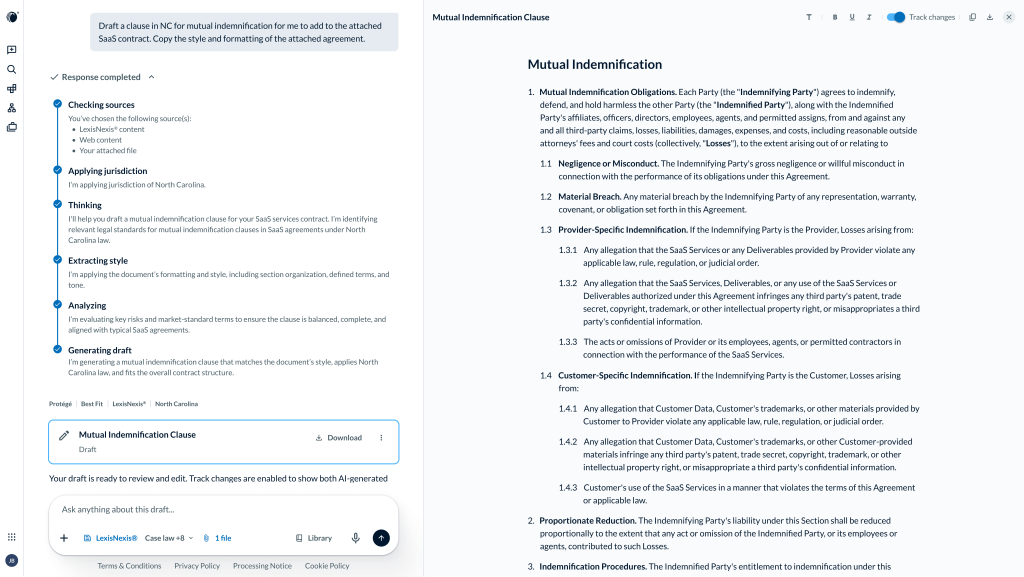
Protégé Agentic Drafting, which LexisNexis describes as a significant expansion of existing drafting capabilities, is a set of purpose-built drafting agents for contracts, motions, briefs and deal documents.
According to the release (I have not yet seen any of this), drafts are grounded in LexisNexis content, firm templates, prior work and matter materials, and can reflect an organization’s preferred style, apply vetted exemplars, preserve formatting and surface risk considerations before the work goes out.
While this sounds similar in some respects to drafting capabilities offered by competitors such as Harvey, Spellbook, Legora and DraftWise, LexisNexis emphasizes that these capabilities are grounded in its own content library and the firm’s own materials.
The release also expands the formats in which Protégé delivers work product. Outputs from Protégé Skills can now be produced in Microsoft Word for drafts, Excel for review tables and structured findings, PowerPoint for client-ready summaries and PDF for polished work product.
Workrooms: A Move into Collaboration
Among the entirely new components in today’s release is Protégé Workrooms, which extends Protégé into shared collaboration.
According to the release, law firms, corporate legal departments and outside counsel can work together in private, permission-aware spaces in which documents, drafts, analysis and AI workflows are shared only as authorized, with dual approvals, least-privilege access, role-based permissions and audit trails.
Arguably, this could place LexisNexis within territory occupied by collaborative deal- and matter-room products such as Litera Transact, HighQ and Legatics, although the emphasis here is on AI-assisted work rather than transaction management.
Shepard’s Verify
Also new in today’s release is Shepard’s Verify Trust Markers, which LexisNexis describes as bringing its citation authority directly into AI-assisted work.
The capability identifies legal citations in both AI-generated and attorney-drafted content, checks them against LexisNexis authoritative sources, and flags citations that cannot be verified as existing.
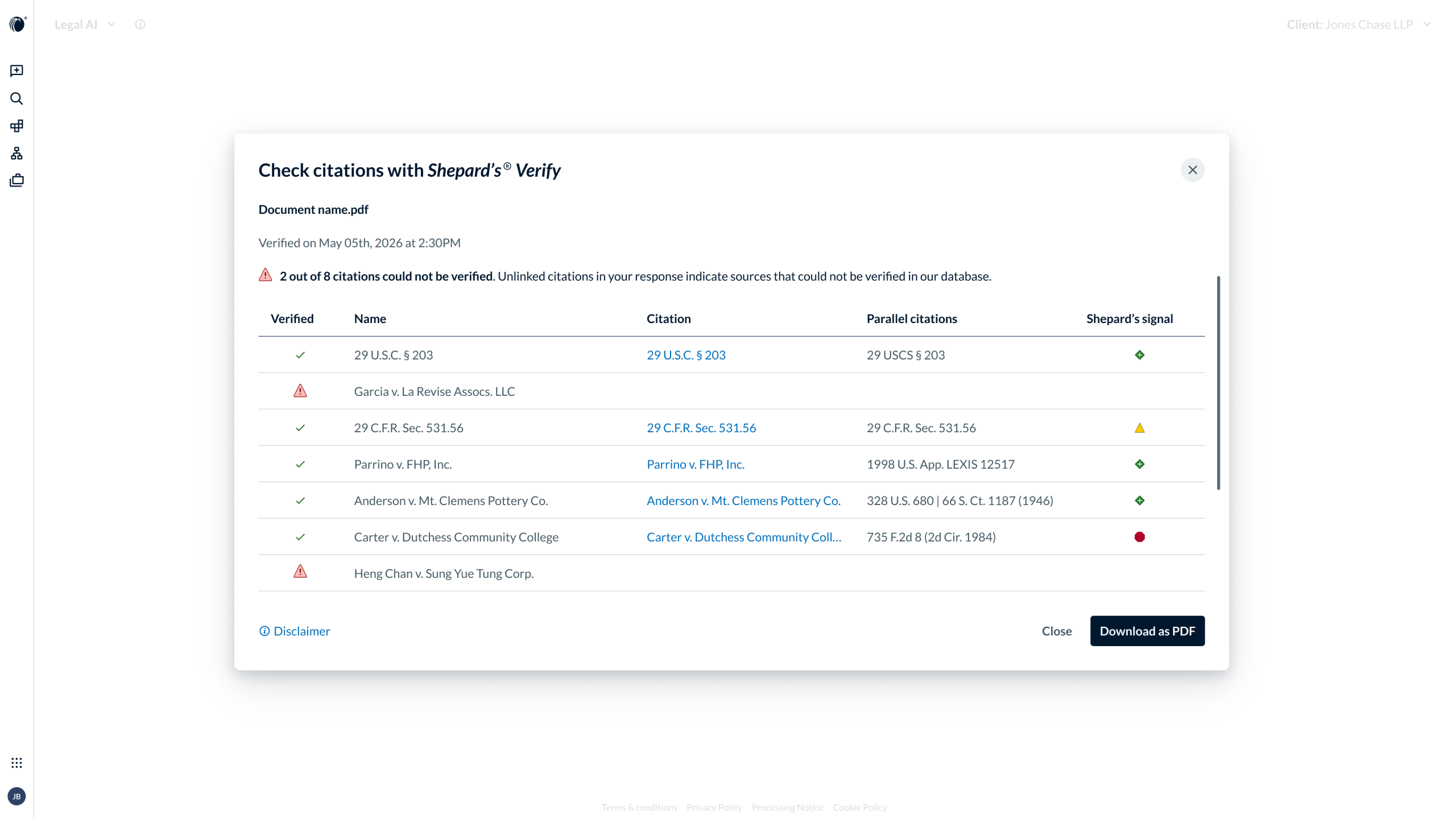
Notably, the capability is described as confirming that “cited authority exists and is retrievable.” That suggests that it is not capable of confirming that a cited authority actually supports the proposition for which it is cited – which is a common failure in AI hallucination cases.
Even so, for lawyers worried about the steady drumbeat of AI hallucination sanctions, embedded citation verification at the point of drafting is a meaningful safeguard, and the timing is notable. The release lands not long after the California State Bar published its proposed rule that would require lawyers to verify every AI output.
To the extent rules like California’s spread, capabilities such as Shepard’s Verify shift from useful safeguards to something closer to essential compliance infrastructure.
An Expanded Vault
Protégé Vault, which previously existed as a secure document workspace within Protégé, has been significantly expanded, according to the release, to support up to 100,000 documents per Vault and to handle PDFs, spreadsheets, images, audio, video and other materials in a single workspace.
Outputs link back to source material for verification, including to exact document passages, spreadsheet rows, images or timestamps.
Notably, the 100,000-document ceiling, combined with the move into multimodal materials including audio and video, gives Vault the document-volume that legal teams need for substantial litigation and transactional matters.
BYOK and Enterprise Trust
Protégé BYOK, also new, allows customers to manage their own encryption keys through their chosen key management service and to revoke access when required.
According to the release, LexisNexis integrates directly with AWS KMS, Azure Key Vault, Google Cloud KMS and HashiCorp Vault, encrypting all customer data at rest using customer-controlled keys.
The company says BYOK has been “deployed in AmLaw 100 firms” following extensive testing.
Content As Differentiator
Following today’s U.S. launch, LexisNexis says the expanded Lexis+ with Protégé will roll out globally throughout 2026.
As noted earlier, the release is the latest in a rapidly developing string of platform announcements from LexisNexis over the past five months, starting with the workflow preview in January, the consolidation and rebrand from Lexis+ AI to Lexis+ with Protégé in February, and now today’s expansion.
Those announcements come against a competitive backdrop that is increasingly intense. Thomson Reuters continues to build out CoCounsel; Harvey has expanded across both contract and litigation work and is securing major firm-wide deployments; vLex’s recently completed acquisition by Clio brings Vincent AI into a much larger distribution platform; and players including Spellbook, Legora and DraftWise continue to push hard on drafting and review.
LexisNexis’s bet, consistent across these announcements, is that ownership of authoritative content, Shepard’s-grade citation infrastructure and enterprise-grade controls will outweigh the speed and product-velocity advantages of newer entrants.